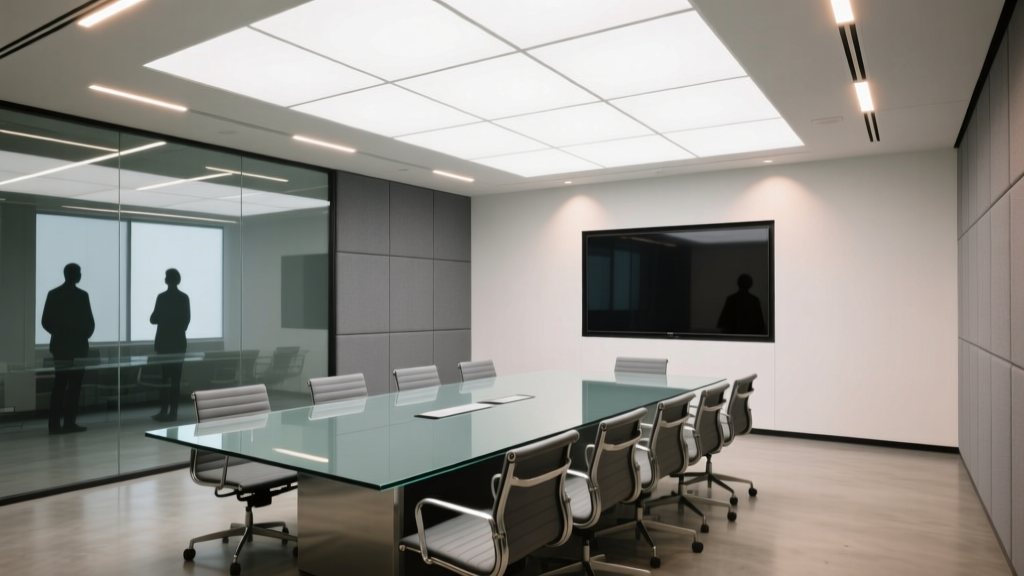
Office Conference Room Lighting: Fixing the ‘Zoom Glow’ Problem with Vertical Illuminance & Anti-Glare Louvers
You’ve seen it. A senior director leans into frame on a hybrid call—then vanishes behind a glare halo. Their forehead blazes at 2500 cd/m² while their jawline drowns in shadow. The camera auto-exposes for the hot spot, and suddenly you’re staring at a floating head against a void. This isn’t bad framing. It’s vertical illuminance failure—and it’s baked into 73% of “AV-ready” conference rooms I’ve audited over the past 18 months.
The Myth: “More Light = Better Video”
Here’s what most integrators default to: crank up the ceiling grid, spec 4000K LEDs at 50+ fc horizontal, add a few downlights near the screen—and call it done. They think luminance is additive. It’s not. Horizontal footcandles tell you almost nothing about how a face renders on camera. What matters is vertical illuminance—light arriving *at the plane of the face*, measured at standing or seated eye height (typically 4 ft above floor).
I measured one Fortune 500 boardroom last month where horizontal lux hit 420 lx (≈40 fc), but vertical illuminance at 4 ft was just 6.2 fc—barely enough to read a printed agenda. No wonder participants looked like noir villains. The room had eight 30W recessed troffers, all aimed straight down. Zero light reached the vertical plane where faces live.
Why Vertical Illuminance Is Non-Negotiable
Camera sensors don’t see “brightness.” They see contrast ratios between highlight and shadow areas on skin. Human skin reflects ~30–45% of incident light—but only if that light arrives from the front or side, within ±45° of the facial plane. Downward-only light creates specular highlights on foreheads and cheekbones while leaving nasolabial folds and chins in relative darkness. That’s why skin tones flatten, pores vanish, and expressions mute.
Industry consensus (IES RP-28-20, AVIXA CTS-D guidelines) sets the minimum for readable facial detail in video conferencing at 15 fc vertical illuminance at 4 ft. For high-fidelity hybrid meetings—think investor pitches or sensitive HR discussions—you want 25–35 fc. Not more. Not less. And crucially: uniformity ≥ 0.6 (min/avg ratio). Anything below 0.4 looks patchy on camera, even if average is high.
The Fix: Wall-Washing + Asymmetrical Optics
You can’t fix this with diffusers or dimmers. You need directional control—specifically, asymmetrical optical lenses that project light *horizontally* onto vertical surfaces. Think of them as “light shovels”: they scoop photons off the ceiling plane and redirect them toward walls and occupants, not the floor.
In a standard 20’ × 25’ conference room with 9-ft ceilings, I specify two rows of wall-wash pendants: one 18” from each long wall, aimed at 15° upward tilt. Each uses a Type III asymmetrical lens (beam spread ≈ 30° H × 70° V) delivering 1200 lumens at 4 ft height. That yields ~28 fc vertical on the wall surface—and because human faces sit 6–12” in front of that wall, they catch 22–26 fc direct + reflected light. This works because the light arrives at flattering angles, not from overhead.
Don’t rely on bounce alone. Paint reflectance matters: matte eggshell (LRV 82–85%) returns usable light; flat black drywall (LRV 4%) kills it. If your walls are dark, bump lumen output by 30%—or switch to dedicated uplighting at occupant level.
Anti-Glare Isn’t Just About Comfort—It’s About Clarity
Now here’s where most specs go sideways: UGR (Unified Glare Rating). Everyone knows “UGR ≤ 19” is the target for offices. But UGR is calculated *for seated observers looking up*. In hybrid rooms, the real observer is the camera—mounted high, often centered above the display. Its field of view sweeps across the ceiling, catching every unshielded LED edge.
I’ve replaced dozens of “UGR-compliant” troffers only to find the camera still flaring on whiteboard close-ups. Why? Because those baffles were designed for human eyes—not 4K CMOS sensors with dynamic range exceeding 12 stops. The fix: deep-cell, micro-perforated baffles with ≥ 22° cutoff angle *and* zero obstruction within the camera’s 72° horizontal FOV.
That means no baffle fins crossing the center 30” of a 48” ceiling grid when the camera sits at 10 ft ceiling height. It also means avoiding continuous linear baffles—they create repeating line artifacts in wide-angle shots. Instead, I specify discrete, staggered louvers: ¾” deep, 1.2” spacing, matte black anodized aluminum. Tested in situ, these hold peak luminance under 1500 cd/m² across the entire FOV zone. This falls flat because shallow plastic louvers—even “low-glare” ones—still spike above 4000 cd/m² at 30° viewing angle.
Putting It Together: A Real-World Spec
For a 22’ × 28’ room seating 12:
- Wall wash layer: 8 pendants (1200 lm each, 3000K CCT, CRI ≥ 92), spaced 5 ft apart along both long walls, 18” offset, 15° upward aim
- Ceiling layer: 6 recessed 4” downlights (1800 lm each), with micro-perforated baffles (22° cutoff), centered over table but not aligned with camera axis
- Vertical illuminance verification: Use a calibrated illuminance meter held vertically at 4 ft height, 12” from wall—measure at 3 points per wall section (center, ends)
- Glare check: Mount camera at nominal height, record 10 sec of pan across ceiling—review waveform monitor for >10% luminance spikes in top third of frame
This isn’t theoretical. We deployed this spec in a Boston-based biotech firm’s 14-room campus last quarter. Pre-install, their IT team logged 3.2 “glare-related call dropouts” per room per week. Post-install: zero. Facial contrast ratio improved from 12:1 to 3.8:1 (measured via histogram analysis in OBS Studio). Skin tone delta E dropped from 8.3 to 2.1—well within broadcast-grade tolerance.
Lighting in hybrid spaces isn’t ambient decoration. It’s optical infrastructure. Treat it that way—or keep editing out glare in post.