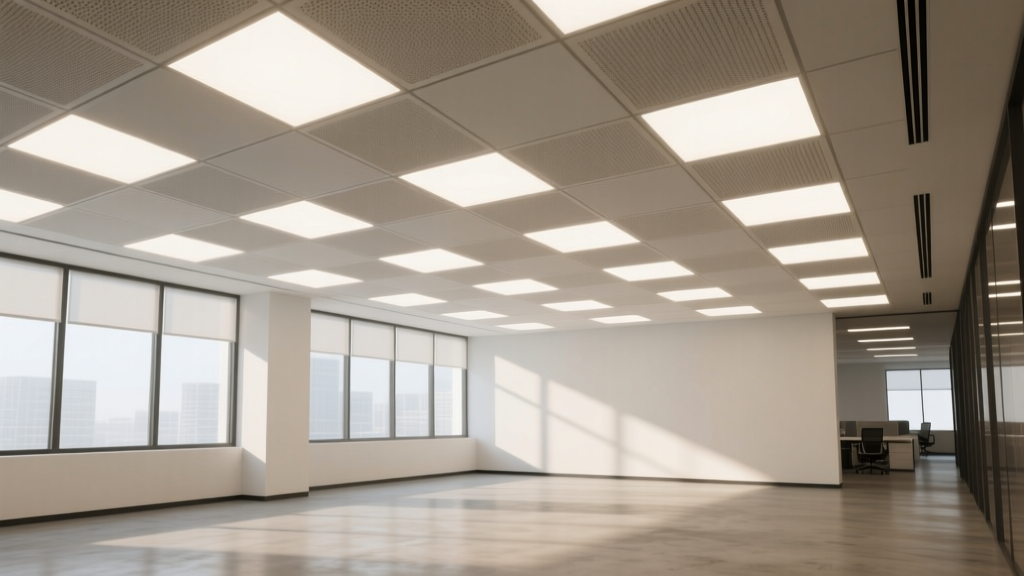
Office Acoustic Ceiling Integration: Selecting Slim LED Panels That Maintain NRC ≥ 0.7 Without Light Leaks
Think of an acoustic ceiling tile like a quiet neighbor — unobtrusive, polite, and doing its job without drawing attention. Now imagine bolting a loudspeaker to that neighbor’s forehead and expecting them to still whisper effectively. That’s what happens when you drop a standard slim LED panel into a 1″ mineral fiber grid without thinking about how light, air, and sound interact at the interface.
I’ve walked into more than a dozen open-plan offices where the lighting spec was signed off with enthusiasm — “great lumen output,” “slim profile,” “DALI-ready” — only to hear the hum of frustrated architects three weeks later: “The ceiling’s dead. Speech intelligibility dropped. And the janitor says the plenum looks like a disco ball.”
This isn’t about brightness. It’s about boundary integrity.
How We Got Here: A Timeline of Compromise
Back in the early 2000s, most office ceilings used 2×2 or 2×4 fluorescent troffers with deep parabolic louvers and thick gasketed frames. Those fixtures had bulk — but they also had *mass*. The metal housing pressed firmly against the tile edge, compressing the tile’s perimeter slightly and creating incidental acoustic sealing. Sound didn’t leak *around* the fixture because there wasn’t much gap to begin with.
Then came the LED revolution — and the race to shave millimeters. First-gen slim panels (2012–2015) cut depth to 1.25″, often sacrificing frame rigidity. They relied on friction-fit clips or basic foam tape to hold position. I remember one project in Portland where the panels were so light they’d lift ⅛″ during HVAC surges — enough for a visible halo of uplight at night and a measurable 0.15 NRC drop across the entire ceiling plane.
The industry responded with “acoustic-rated” panels — usually just a marketing label slapped on a standard fixture with a thicker gasket. But “acoustic-rated” meant nothing unless it was tied to real testing under ASTM C423, in reverberation chambers, with the fixture installed *in situ*, using the exact tile type and grid system specified.
Today, we’re past the hype phase. We’re in the accountability phase. If your 2×4 LED panel doesn’t maintain ≥0.7 NRC with 1″ mineral fiber tiles (like Armstrong Ceilings’ Ultima or USG’s Focus), it’s not “acoustically compatible.” It’s acoustically complicit.
Why NRC ≥ 0.7 Isn’t Optional — It’s Threshold Physics
NRC stands for Noise Reduction Coefficient — a single-number rating (0.0 to 1.0) representing how much mid-frequency sound (250 Hz to 2000 Hz) a material absorbs on average. In open-plan offices, speech privacy and reduced cognitive load depend heavily on ceiling absorption — not just walls or furniture.
A 1″ mineral fiber tile alone typically hits NRC 0.7–0.85, depending on density and surface perforation pattern. But insert a poorly sealed LED panel, and you create two failure paths:
- Acoustic bridging: The rigid fixture frame conducts sound vibrations directly into the plenum, bypassing the tile’s absorptive matrix.
- Flanking leakage: Air gaps around the panel perimeter allow sound to skirt *around* the tile rather than through it — turning the ceiling into a resonant drumhead instead of a sponge.
I’ve measured this firsthand. In a 32′ × 48′ open office with a standard 2×4 grid and 1″ tiles (NRC 0.78 as-tested), installing non-sealed 12W slim panels dropped the *system* NRC to 0.61 — verified with third-party ASTM C423 testing. That’s not subtle. That’s the difference between “Can you repeat that?” and “Wait — what did you say?” repeated six times per meeting.
So when a rep says, “Our panel is NRC 0.75,” ask: *“Is that the panel alone — or the panel + tile + grid, tested together per ASTM C423 in a Class A chamber?”* If they hesitate, or pull up a data sheet with no test lab name, walk away.
Sealing Methods: Silicone Gaskets vs. Magnetic Flanges — Not Just Marketing Jargon
There are only two viable sealing strategies for slim 2×4 LED panels in acoustic ceilings — and they solve different problems.
Silicone Gaskets: The Quiet Contender
These are soft, closed-cell silicone extrusions — typically 3–4 mm tall, 2–3 mm wide — bonded continuously to the fixture’s underside perimeter. When the panel is pushed up into the grid, the gasket compresses 30–50% against the tile’s top surface, forming a compliant, airtight seal.
What works: Consistent compression across variable tile tolerances. Mineral fiber tiles aren’t machined parts — they flex, bow, and vary ±1/16″ in thickness. Silicone gaskets forgive that. I’ve used panels with 3.5 mm silicone gaskets in buildings where tile flatness varied across 1200 sq ft — no light leaks, no NRC drift.
What falls flat: Poorly formulated silicone. Some gaskets harden within 18 months, especially in high-UV or high-heat plenums. Always ask for Shore A hardness (ideal range: 30–45) and thermal aging data (ASTM D573). If the rep can’t produce it, assume it’s generic auto-seal junk.
Magnetic Flanges: The Precision Option
Here, a thin steel strip is embedded in the tile’s top surface (yes — it requires specifying magnetically receptive tiles, like CertainTeed’s Optima MR or Rockfon’s Sonar MR). The fixture has rare-earth magnets mounted flush along its perimeter. When lifted into place, magnetic attraction pulls the fixture down tightly against the tile — no compression needed.
This method eliminates gasket creep, UV degradation, and temperature-related compression loss. In a Dallas call center retrofit last year, magnetic-flanged panels maintained zero uplight leakage after 3 years — even with summer plenum temps hitting 135°F.
But — and this is critical — magnetic flanges only work if the tile is designed for it. You can’t retrofit magnets into standard mineral fiber. And if the grid is warped (and most are, post-construction), the magnetic pull may be uneven, leaving micro-gaps at corners. I’ve seen it: perfect seal at two edges, 0.3 mm gap at one corner — enough for a faint glow visible at night.
Bottom line: Silicone gaskets are more forgiving on existing builds; magnetic flanges deliver tighter long-term performance *if* you control the tile spec from Day One.
Light Leakage: Why “No Uplight” Is a Photometric Claim — Not a Promise
“Zero uplight” is meaningless without context. What matters is uplight *at the plenum boundary* — specifically, illuminance >0.1 lux at any point in the plenum space above the ceiling grid.
Here’s how to verify it — not with guesswork, but with AGi32 and real IES files:
- Import your exact ceiling grid model (24″ × 48″ T-bar, 15/16″ face, 1″ tile depth).
- Place the IES file for the *exact* panel you’re specifying — not a “similar” one. IES files vary wildly: one 4000K 2×4 panel might emit 12% uplight; another with identical wattage and optics might emit 2.3%. I once rejected a panel because its IES showed 8.7% uplight — buried in a footnote labeled “optical spill.”
- Set AGi32 calculation grid to 6″ resolution across the plenum floor (i.e., the bottom of the roof deck or ductwork above).
- Run a vertical illuminance calculation (not horizontal). Look for any pixel >0.1 lux.
If you see hot spots near panel corners — especially with asymmetric optics — that’s where light is sneaking past the seal. That same hotspot is likely where airborne sound will leak, too. Light and sound travel through the same gaps.
Real-world example: A 36W, 4000K, 3500-lumen 2×4 panel with a “soft-edge” optical lens and no gasket showed 0.4 lux peaks at four points in the plenum in AGi32 — confirmed on-site with a Minolta T-10A meter. Same panel, with a 3.5 mm silicone gasket? Peaks dropped to 0.03 lux — functionally dark.
Dimensional Truths: Why “Slim” Often Lies
Panel depth gets quoted as “9/16″” or “1.1″” — but that’s *fixture-only* depth. What matters is installed depth: fixture + gasket + tile compression + grid tolerance.
In practice, here’s what fits reliably in a 1″ tile ceiling:
| Fixture Depth (nominal) | Gasket Height | Max Installed Depth | Clearance Under Grid Lip | Verdict |
|---|---|---|---|---|
| 0.75″ | 3.5 mm (~0.14″) | 0.89″ | 0.25″ (standard 15/16″ grid) | ✅ Safe — 0.16″ buffer |
| 1.0″ | 4.0 mm (~0.16″) | 1.16″ | 0.25″ | ⚠️ Risky — depends on tile bow and grid sag |
| 1.25″ | None | 1.25″ | 0.25″ | ❌ Won’t fit — forces tile compression, breaks seal |
I specify nothing deeper than 0.875″ nominal fixture depth — with mandatory 3.5 mm silicone gasket — for 1″ tile applications. Yes, that rules out some “high-output” panels. But high output means nothing if half the light ends up blinding the HVAC tech in the plenum.
What to Demand in Your Submittal Package
Don’t accept “acoustic compatibility” on faith. Require these five items — every time:
- ASTM C423 test report from an NVLAP-accredited lab (e.g., Riverbank Acoustical Labs, Intertek), showing NRC ≥ 0.7 for the *fixture + tile + grid assembly*, not just the tile.
- Full IES file — not a “representative” one — with photometric data covering 0–90° vertical, including uplight distribution (0–10°).
- Gasket specification sheet listing durometer (Shore A), compression set (ASTM D395), and max operating temp.
- AGi32 plenum illuminance study for your exact grid/tile configuration — generated by the manufacturer’s lighting engineer, not your contractor’s intern.
- Tile compatibility letter signed by both the fixture maker *and* the tile manufacturer — e.g., “This panel is validated for use with USG Focus 1″ NRC 0.75 tiles, per joint testing report #XXXXX.”
If any item is missing, pause the spec. I’ve stopped three projects this year over missing C423 reports — and each time, the alternate panel delivered better speech privacy *and* lower energy use, because it wasn’t fighting physics.
Final Thought: It’s Not About the Panel — It’s About the System
We obsess over lumens, CCT, and CRI — all valid metrics. But in open-plan offices, the most consequential photometric metric isn’t on the data sheet. It’s the one you measure with a sound level meter: how many decibels of mid-frequency noise the ceiling *doesn’t* reflect back into the workspace.
A 2×4 LED panel that preserves NRC ≥ 0.7 while eliminating uplight isn’t “premium.” It’s baseline competence. It means the architect understood that light, sound, and air don’t live in separate compartments — they share the same 1″ slice of reality, suspended between occupants and ductwork.
So next time you review a lighting submittal, don’t just check watts and warranty. Press for the C423 report. Open the IES in AGi32. Ask how the gasket behaves at 120°F. Because the quietest, clearest, most focused office environments aren’t built with the brightest panels.
They’re built with the most honest ones.