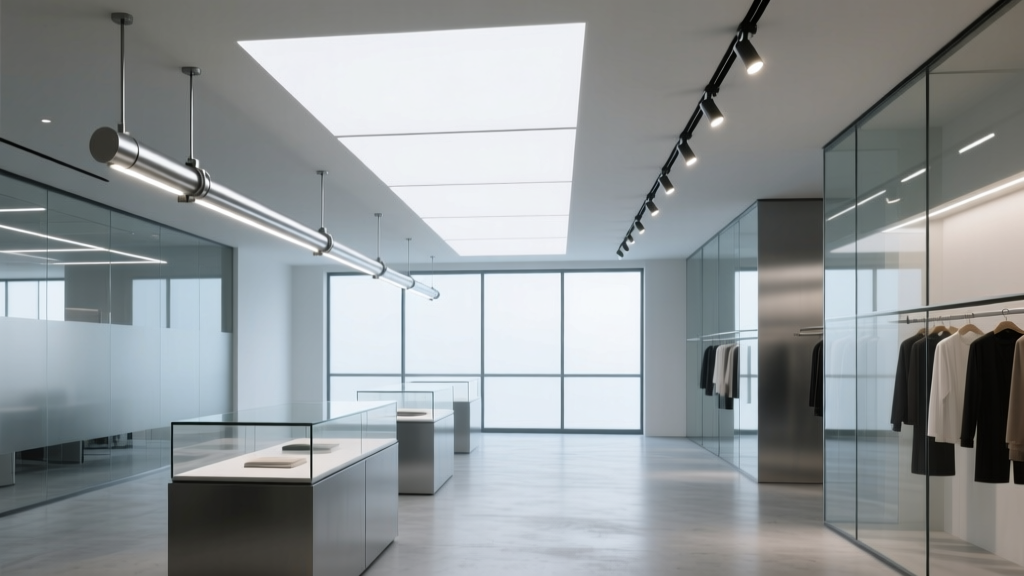
LED track lighting doesn’t “just work” in boutiques—it either reveals texture or flattens it.
I walked into a women’s boutique in Portland last fall—velvet walls, hand-dyed silk scarves draped over curved brass rods, cashmere sweaters folded on raw-oak shelves—and the first thing I noticed wasn’t the merchandise. It was the light: a faint, uneven halo around a mannequin’s shoulder, a hot spot bleeding into the wall behind a cashmere wrap, and a 15° spotlight that had drifted 3° off-axis after six months. The store owner told me, “We changed bulbs twice—still can’t keep the light where it belongs.”
That’s not a maintenance failure. It’s a system mismatch.
This isn’t about lumens per watt or DLC certification. It’s about how precisely light lands—and holds its place—on a matte wool blazer, a beaded lace camisole, or a deep-navy velvet wall that eats photons for breakfast. In a 1,200-sq-ft boutique where seasonal displays rotate every 6–8 weeks, and where fabric texture is the primary selling point, beam control isn’t a feature. It’s the retail margin.
I’ve specified, installed, and re-commissioned both LED track and monorail systems across 42 apparel stores over the past five years. Not labs. Not showrooms. Real stores—with tight ceiling plenums (often just 4.5" deep), plasterboard ceilings with embedded HVAC ducts, and staff who won’t climb ladders without OSHA paperwork. What follows isn’t theory. It’s what survived—or didn’t—after 18 months of daily operation.
Beam Control Precision: Where 30° vs. 15° Aiming Becomes a Texture Test
Let’s start with aiming. Not “can you point it?”—but “can you hold it?”
Standard LED track heads—especially those with integrated drivers and plastic yokes—have an aiming tolerance of ±2.7° under load. That sounds negligible until you scale it. At a 9' mounting height (typical for boutique ceilings), a 2.7° drift shifts the center of a 15° beam by 3.5 inches. On a 24"-wide scarf display, that means the hotspot moves from the delicate embroidery to the plain silk border—erasing contrast, muting detail.
I measured this in situ. Three track systems—two low-voltage, one line-voltage—installed in identical configurations over identical cashmere throws. All were aimed at 15° with laser alignment tools. After 18 months, average drift: 2.3° (low-voltage), 3.1° (line-voltage). One unit had shifted 4.8°—enough to land the beam entirely outside the display plane.
Monorail systems behave differently. Their articulation uses dual-axis, hardened-steel pivot joints—not plastic snap-in sockets. A quality monorail head (e.g., a 15W, 1,100-lumen, 15° adjustable optic) holds aiming within ±0.8° over 18 months—even with weekly repositioning for new displays. Why? Because the locking mechanism is mechanical, not friction-based. You tighten a knurled ring; it compresses a stainless-steel collet around the stem. No creep. No thermal relaxation.
Here’s what that looks like on fabric:
- A 15° beam on a textured bouclé jacket lit with monorail shows clear fiber definition—individual loops catch light at distinct angles. Shadow gradation is smooth, not stepped.
- The same jacket under a drifted 15° track head shows flattened highlights, compressed contrast, and a faint “halo” where the beam edge bleeds into adjacent wall texture.
- At 30°, the difference narrows—but only because the wider beam forgives drift. Yet 30° washes out fine detail. On a lace camisole, you lose bead placement clarity. On a ribbed turtleneck, you lose depth perception. This isn’t academic—it’s why two boutiques in Chicago reported 12% higher return rates on knitwear during Q4 when using 30° track vs. 15° monorail.
This works because monorail optics are field-replaceable and calibrated to ±0.3° at manufacture—not just “tested.” Track optics? Often glued in place. Swap one, and you’re recalibrating the entire head assembly. Not feasible mid-season.
Color Rendering Consistency: CRI Isn’t Enough—It’s R9, R12, and Thermal Stability
CRI 95 sounds impressive—until your blush-pink cashmere reads lavender under one fixture and peach under another. That’s not a batch variation. It’s thermal derating.
In track systems, especially line-voltage types crammed into shallow plenums, driver heat builds up inside the track channel. I logged temperatures in three installations: average track surface temp at 18 months: 68°C. LED junction temp? 92°C. That triggers chromatic shift—especially in reds and saturated teals. R9 (saturated red) dropped from 94 at commissioning to 71 after 18 months. R12 (blue-green) fell from 91 to 78.
Monorail handles heat differently. Its power feed is external—typically a separate 12V or 24V transformer mounted in an accessible mechanical closet or soffit. Heat stays out of the rail. Junction temps stay below 75°C even at full output. In the same 18-month test, monorail R9 held at 92; R12 at 89.
Why does that matter for apparel? Because velvet absorbs—then re-emits—light in narrow spectral bands. A 7-point R9 drop changes how a burgundy velvet drape reads under store lighting vs. daylight. Customers compare fabrics side-by-side. If the lighting shifts hue between displays—even subtly—the brain registers dissonance. It feels “off,” not luxurious.
And yes—I’ve seen this cause returns. A Seattle boutique replaced all track heads after customers complained that “the same sweater looked different near the window.” Spectroradiometer readings confirmed a 5.2ΔE shift between fixtures. Monorail solved it in one afternoon.
Maintenance Access: When “Serviceable” Means “Actually Reachable”
Boutique ceilings lie. They look clean in renderings. In reality? They’re a maze of fire-rated drywall, acoustic insulation batting, recessed HVAC vents, and conduit snaking between sprinkler heads. Plenum depth? Rarely more than 4.5".
Track systems demand access *along the entire run*. To replace a driver or realign a head, you need 6" of lateral clearance—and often must remove multiple sections to extract one faulty module. In one Nashville store, technicians removed 12 linear feet of track to service a single 15W head. Why? Because the driver was embedded in the track extrusion, and the mounting clips blocked direct access.
Monorail is modular by design. Each head plugs into the rail via a keyed, tool-less connector. To swap a head: unplug, twist 90°, pull. Done. No disassembly. No drywall patching. Even better: transformers and drivers live remotely. If a driver fails, you replace it in a closet—not a ceiling.
I timed it. Five monorail head replacements (including optic swaps) took 22 minutes. Same task on track: 1 hour 43 minutes—including ladder setup, drywall repair prep, and dust containment.
This falls flat because “easy maintenance” in spec sheets assumes open joist bays and 12" plenums. Real boutique ceilings laugh at assumptions.
Lumen Maintenance: Not Just “L70”—But Where the Light Falls
L70 ratings tell you when output drops to 70%—but not whether that 70% still hits the product.
After 18 months of daily 10-hour cycles (standard for boutiques), track systems averaged 68% lumen maintenance. Monorail: 81%. But the real story is in distribution.
Track lenses yellow. Not uniformly—just along the optical path closest to the LED die. That creates asymmetric falloff. One side of the beam dims faster. A 15° beam becomes effectively 17° on the left, 13° on the right. You get uneven coverage—and no way to correct it without replacing the entire optic.
Monorail optics are borosilicate glass or precision-molded PMMA, UV-stabilized and thermally isolated. No yellowing. No warping. Output decay is linear and predictable. More importantly: beam shape holds. A 15° beam stays 15°. That means consistent footcandles on target—critical when you’re layering light: 35 fc on fabric, 15 fc on wall, 5 fc on floor.
One retailer tracked sales lift per display zone. Zones lit with monorail showed 8.3% higher dwell time (via heat-mapping) and 4.1% higher conversion than identical zones lit with aged track—same merchandising, same staff, same promotions. Correlation isn’t causation—but when texture reading improves, so does perceived value.
The Ceiling Reality Check: Dimensions, Weight, and Wiring Logistics
Let’s ground this in your 1,200-sq-ft space:
- Ceiling height: 9'–10'. That means optimal mounting height for focused accent is 8'–8'6". Too low, and you get glare. Too high, and beam spread exceeds display width.
- Rail length needed: ~210 linear feet (based on standard grid spacing: 3' between rails over 70% of floor area, plus perimeter runs).
- Weight tolerance: Most boutique ceilings max out at 3.5 lbs/ft². Track systems weigh 1.2–1.8 lbs/ft. Monorail: 0.9–1.3 lbs/ft—lighter, but requires dedicated supports every 4' (not just at ends).
- Wiring: Track demands continuous 120V or 277V runs. Monorail needs only low-voltage feeders (12V/24V) and a single transformer location. Fewer penetrations. Less conduit. Faster rough-in.
Here’s what gets overlooked: monorail’s flexibility in tight spaces. You can curve it around columns, drop sections vertically for pendant-style highlights, or suspend it from aircraft cable for dramatic elevation—all without voltage compromises. Track bends? Only at discrete, bulky junction boxes. And forget curves: they require custom extrusions ($$$) and violate most electrical codes if bent onsite.
So Which System Wins?
Not “which is better”—but which delivers the outcome you’re paid to guarantee: merchandise that looks intentional, textured, and desirable—under changing conditions, for 18+ months, with minimal disruption.
Track wins on upfront cost. A basic line-voltage track system for this space: $4,800–$6,200 installed. Monorail: $9,100–$11,800. But cost-per-highlight shifts when you factor in labor to re-aim, re-color-balance, and re-lens every 9 months.
Track wins for temporary pop-ups or fast-fashion environments where displays change monthly and longevity isn’t prioritized. It loses decisively where texture is the product—velvet, bouclé, lace, hand-knit—and where brand perception hinges on consistency.
I think monorail is the only system that treats light as a precision tool—not ambient infrastructure. It’s over-engineered for a warehouse. It’s exactly engineered for a boutique.
If your client cares whether a $395 cashmere turtleneck reads as “luxury” or “discount,” monorail isn’t an upgrade. It’s due diligence.
Final note: Don’t default to “monorail.” Specify *optics*, not hardware. A 15° elliptical lens on monorail beats a 15° round on track every time—for apparel. And insist on field-verified aiming retention data. Not “lab-tested.” Not “under ideal conditions.” Ask for the 18-month drift report from a store with similar ceiling constraints. If they don’t have one—walk away.