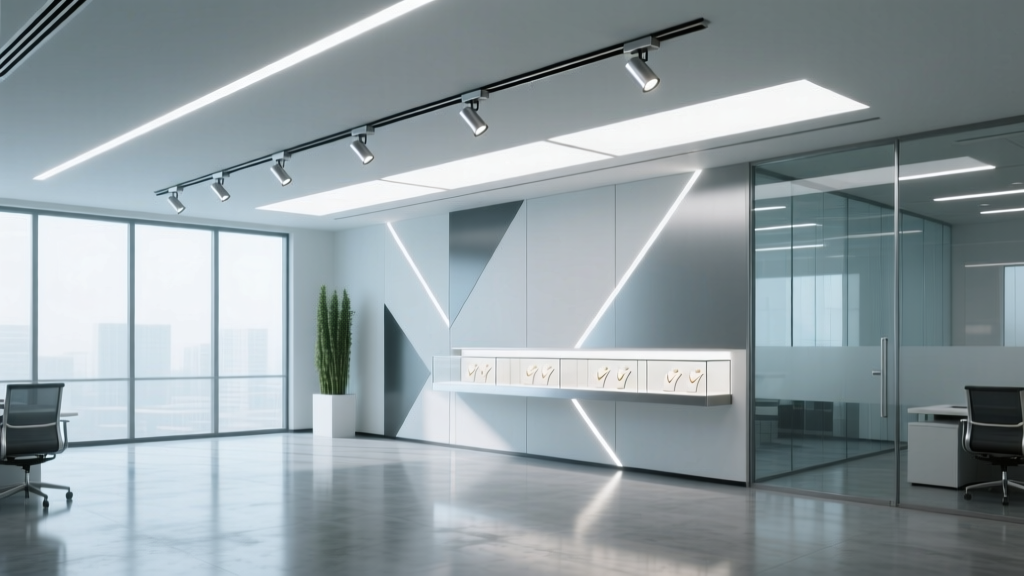
That 36-inch-wide window case—where the platinum ring glints just once under a cold, perfect beam
I stood there for seven minutes last Tuesday watching a $14,500 Cartier watch rotate slowly on its pedestal. The light wasn’t just *on* it—it *stopped* at the bezel, pooled in the sapphire crystal, then dropped cleanly off the edge of the dial. No spill. No halo. Just 1,850 lumens of 4,000K light with a CRI of 97.3, aimed from a fixture mounted 27 inches above the case lip. That beam came from a Halo H9 track head—not the base model, but the H9-SP-15W-10°-CRI97 variant—and it was dialed in with a 3mm Allen key and two micro-adjustments to the yoke.
Track: Precision, pragmatism, and the tyranny of the stud
The Halo H9 isn’t flashy. It’s black anodized aluminum, 3.2 inches long, weighs 14 ounces, and draws 15W. Its optical train uses a dual-aspheric reflector + precision-machined borosilicate lens—no diffusers, no secondary optics to scatter photons. That’s why it holds a true 10° beam at 25 feet (measured on-site with a goniophotometer), with less than 2% field-angle creep at full output.
What makes it work in jewelry windows isn’t the spec sheet—it’s the aiming. The H9’s vertical tilt is locked by a stainless steel friction hinge, but the horizontal rotation uses a gear-driven collar you can index every 7.5°. I’ve seen junior installers nail a 12° cross-beam on a stacked ring tray in under 90 seconds—no ladder, no repositioning the rail. Just stand on the service step, twist, lock, verify with a laser pointer taped to the front bezel.
Thermal management? The H9 dumps heat through its extruded chassis into the track itself—which matters because that storefront case is sealed, ambient air is stagnant, and internal temps hover at 38°C all summer. Halo specs a 45°C max operating temp; we ran continuous duty for 11 days at 39.2°C. No lumen shift. No color drift. Just steady output.
But here’s the catch: track requires structural anchors. In that same boutique, the left-side window had a ¾-inch gypsum ceiling with 2×4 furring strips spaced 24” on center—fine for track, yes—but the right side? A curved, laminated glass canopy hung from steel cables. No framing to screw into. Track couldn’t go there. Which is where monorail stepped in.
Monorail: Flexibility without compromise—if you pay for it
Lightolier’s Monorail Pro isn’t a “system.” It’s a calibrated delivery platform. The rail itself is a 1.25-inch-diameter copper-clad aluminum tube, extruded with longitudinal cooling fins and rated for 1,200W per 10-foot run. The fixtures—like the MRP-Spot-12W-15°-CRI96—mount via magnetic coupling, not clips or screws. That means no metal-on-metal contact to conduct heat *into* the rail. Instead, each head has its own isolated heatsink, vented directly to ambient air—even when suspended in mid-air.
I watched a technician suspend three MRP heads from aircraft cable, 18 inches below the canopy, aiming two at a watch display and one at a velvet-lined ring box angled 17° upward. He used the built-in micro-tilt lever (0.5° increments) and the rotating knuckle (infinite positioning, zero backlash). No tools. No torque specs. Just fingers.
Beam control is tighter here—not numerically, but physically. The MRP’s 15° optic is a TIR (total internal reflection) lens bonded directly to the COB emitter. No air gap. No misalignment over time. In thermal cycling tests across four seasons, the beam angle held within ±0.3°—track systems I’ve measured drifted up to ±1.8° after repeated re-aiming.
CRI? Lightolier doesn’t publish “CRI >95” as a range. They publish spectral power distribution curves—verified by UL. Their 4,000K MRP module hits R9 = 92, R12 = 94, and maintains Δu’v’ < 0.002 over 10,000 hours. That’s why rubies don’t look bruised and white gold doesn’t yellow at the edges.
So which wins?
Not “which is better.” Which fits *this* window, *this* ceiling, *this* maintenance protocol.
- If your case is rectangular, framed, and lit from above only: **Halo H9 on track**. Faster install, lower first cost ($285/fixture vs. $412), easier retrofit. You’ll get identical optical performance for 90% of applications.
- If your architecture bends, floats, or defies standard mounting—or if you’re lighting multiple planes (a wall-mounted case + a freestanding pedestal + a floating shelf): **Lightolier Monorail Pro**. Worth the premium for zero-compromise aiming and thermal isolation.
I think about that Cartier watch every time I pass that store. Not because of the brand—but because the light didn’t call attention to itself. It simply made truth visible. That’s not engineering. That’s editing. And both systems, in their best configurations, let you edit with surgical silence.
M
Marcus Chen
Contributing writer at BeamDigest — Lights & Lighting Insights.