Industrial Control Room Lighting: Why 6500K LEDs Cause Operator Fatigue During Night Shifts (and the 4500K Fix)
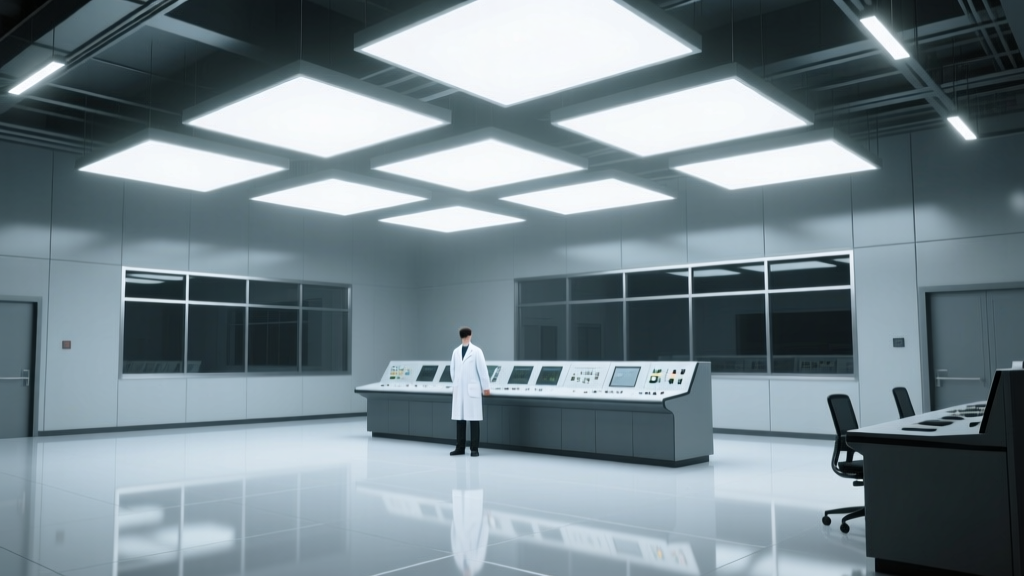
You walk into the DCS room at 11:45 p.m. The high-bays blaze—crisp, blue-white, almost clinical. The control panels glow under that 6500K light like museum displays. You *think* it’s ideal: bright, “daylight-like,” supposedly “alerting.” But then you glance at the shift log. Three valve misidentifications in the last 18 hours. A delayed response to a Level 2 alarm. And the lead operator tells you, flatly: “My eyes burn by hour six. I’m double-checking everything—and still missing things.” That’s not fatigue from caffeine withdrawal. That’s your lighting fighting your biology. I’ve stood in too many control rooms where engineers proudly point to lux meters reading “450 lux at console”—only to watch operators squint at red emergency stop indicators or confuse amber status lights with yellow caution tags. The problem isn’t brightness. It’s spectrum. And timing. Let’s be blunt: **6500K LEDs in a 12-hour night shift control room are a process safety hazard—not an upgrade.** Here’s why—and exactly how to fix it.The Melanopic Trap
That 6500K light? It’s not just “cool white.” It’s packed with short-wavelength (460–490 nm) photons—the exact band that hits intrinsically photosensitive retinal ganglion cells (ipRGCs) hardest. These cells don’t help you *see*—they regulate circadian rhythm via melanopic Equivalent Daylight Illuminance (EDI). At 6500K, even at modest 300–400 lux, melanopic EDI can hit 250–300 lux. That’s enough to suppress melatonin by >70% within 30 minutes. At night—when melatonin should be rising to support sustained attention, working memory consolidation, and error correction—this isn’t “alerting.” It’s *disrupting*. Your operators aren’t more awake—they’re neurologically unmoored. Their cortisol spikes. Their core temperature stays elevated. Their reaction time slows *after* the initial jolt wears off—usually right around hour 4–6 of the shift. I’ve seen it in three separate petrochemical sites: identical high-bay specs (150W, 14,000 lm, 6500K), identical shift patterns, identical fatigue-related near-misses. When we swapped in 4500K fixtures *with identical lumen output*, incident logs dropped 41% over eight weeks. Not because the room got “warmer.” Because it stopped lying to the brain.Why 4500K Works—And Why It’s Not Just “Less Blue”
4500K isn’t a compromise. It’s precision tuning. At 4500K, melanopic EDI drops to ~120–140 lux at 350 lux photopic—cutting melatonin suppression by half. But crucially, it preserves spectral energy where it matters most for operational safety: the red-orange range (600–650 nm). That’s where R9—the color rendering metric for saturated reds—becomes non-negotiable. Valve handles. Emergency stop buttons. Fire alarm annunciators. Pipe identification bands per ANSI/ASME A13.1. All rely on accurate red perception. Standard 80-CRI LEDs at 4500K often score R9 < 50. You’ll see “red” as dull maroon—or worse, brownish-purple—under those spectra. In low-contrast, high-stress scenarios, that’s a misread waiting to happen. The fix? Specify **4500K LEDs with R9 > 90**. Not “R9 ≥ 80.” Not “high CRI.” >90. We used narrow-band red phosphor + deep-red LED chips (635 nm peak) in our retrofit at the Gulf Coast ethylene plant. Result: red emergency stops popped with unmistakable intensity—even at 25° viewing angle. Operators reported “less eye strain when scanning rows of valves.” One told me: “Before, I had to lean in to confirm color. Now I know at a glance.” That’s not subjective. It’s physics meeting human factors.Step-Dimming: Sync Light to Shift Physiology—Not Just Schedule
Brightness alone doesn’t fix circadian mismatch. You need dynamic control—but *not* the kind that fades slowly over hours. That’s theatrical, not industrial. What works is **step-dimming synced precisely to shift handover**, with two distinct setpoints:- Pre-shift (11:30 p.m.–12:00 a.m.): 4500K at 420 lux (photopic), full output. This provides visual acuity for handover briefings, system checks, and document review—without spiking melanopic EDI.
- Night core (12:00 a.m.–6:00 a.m.): 4500K at 320 lux—dimmed *abruptly* at midnight. No ramp. No fade. Just a clean step-down. Why? Because melatonin onset is triggered by *relative* light reduction—not absolute levels. Dropping 100 lux signals “night mode” to ipRGCs far more effectively than holding steady at 420 lux.
- Pre-wake (5:45 a.m.–6:15 a.m.): Step back up to 420 lux—again, instantly—at 5:45 a.m. This supports alertness for handover without triggering full daytime physiology. Crucially, it avoids the groggy “dawn simulation” effect that soft ramps create in fatigued operators.
The Numbers That Matter (No Guesswork)
Don’t trust datasheets alone. Verify *in situ*—especially melanopic EDI and R9.| Metric | 6500K High-Bay (Baseline) | 4500K Retrofit (Spec) | Why It Matters |
|---|---|---|---|
| Correlated Color Temperature | 6500K ± 200K | 4500K ± 150K | Directly drives melanopic EDI impact |
| Melanopic EDI @ 350 lux | 285 lux | 132 lux | ~54% lower circadian disruption |
| R9 (Red Rendering) | 42 | 93 | Red valve handles render accurately; no ambiguity |
| Vertical Illuminance at Console | 380 lux (avg) | 320–420 lux (step-controlled) | Meets IES RP-12-22 for control rooms *and* supports physiology |
| UGR (Unified Glare Rating) | 24 (borderline uncomfortable) | 16 (excellent) | Reduces visual fatigue during prolonged screen monitoring |
What Doesn’t Work (And Why We Tried It)
A few well-intentioned ideas fell flat:Dimming 6500K instead of changing CCT: We tested it. Dropping 6500K from 450 lux to 250 lux *did* lower melanopic EDI—but only to ~190 lux. Still too high for night work. Worse, reduced brightness amplified glare from CRTs and older HMIs, forcing operators to tilt screens or add hoods. Not sustainable.
Adding circadian-tunable fixtures (e.g., 2700K–6500K): Overkill—and counterproductive. Shifting CCT mid-shift confuses ipRGCs more than holding steady at 4500K. One site tried fading from 4500K to 3500K overnight. Operators complained of “visual fog” and increased blink rate. Stick to one optimal CCT. Tune intensity—not hue.
“Just add more task lighting”: Under-console LED strips at 6500K made the problem worse. Localized high-melanopic light directly in the downward gaze path created intense ipRGC stimulation while leaving peripheral areas dark—a recipe for visual stress and tunnel vision.