Hospitality Lighting Code Checklist: Emergency Egress Path Marking for Boutique Hotel Stairwells
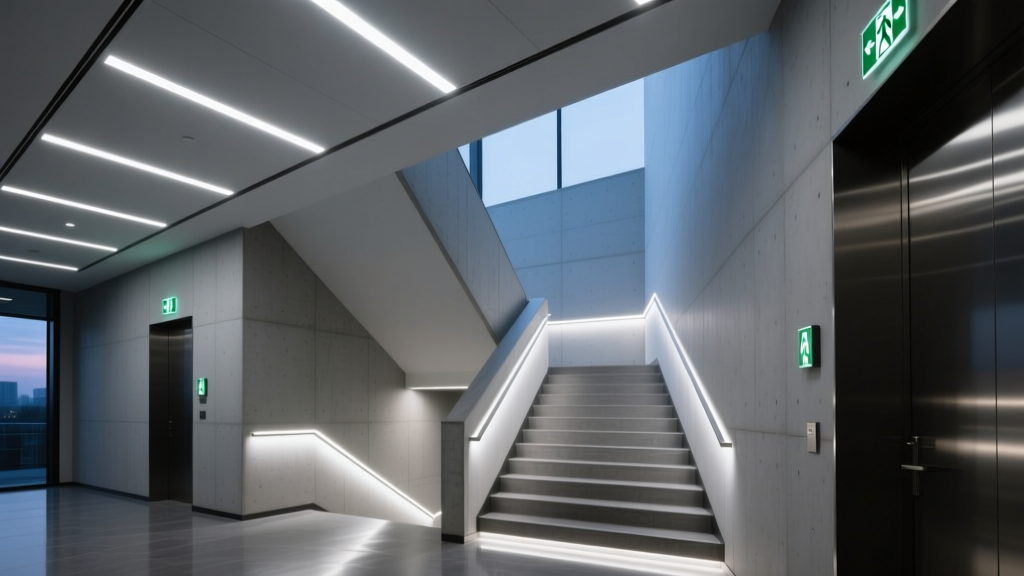
The third-floor stairwell of The Marlowe House — a 42-room boutique hotel in Portland, Oregon — smells faintly of cedar oil and concrete dust. At night, when the main lights cut out during a scheduled utility test, I watched the egress path activate: slim LED step markers glow warm amber at the leading edge of each tread, while low-level wall-mounted photoluminescent strips pulse softly at 18 inches above the floor. It’s not dramatic. It’s legible. And it passed inspection — on the first try.
That’s rare. In my six years reviewing lighting submittals for small- to mid-size hospitality projects, I’ve seen stairwells fail for reasons that seem trivial until they’re flagged: a single step marker mounted 13.2 inches above nosing (0.2” over limit), a driver labeled “UL 924 listed” but missing the *self-testing* suffix, or photometric readings showing 1:52 uniformity across a 12-step run — just outside the NFPA 101 1:40 max ratio.
Here’s what actually matters on-site — distilled from IBC 2021 Chapter 10, NFPA 101-2021 Sections 7.8–7.10, and three recent Portland Bureau of Development Services stairwell inspections.
Non-Negotiables (IBC 2021 + NFPA 101 Alignment)
- Mounting height: Step-edge LED markers must be installed no more than 12 inches ± ¼ inch above the leading edge (nosing) of each tread. Not “approximately,” not “within tolerance of drywall finish.” Measure from the finished nosing surface with a calibrated tape. I’ve seen inspectors use laser levels — and reject a full string because one bracket was shimmed 3/8” too high during dry-in.
- Uniformity ratio: Measured footcandles at the walking surface must not exceed a 1:40 ratio between brightest and dimmest point along the egress path — including landings, turns, and door thresholds. This isn’t theoretical. You need a calibrated illuminance meter (e.g., Sekonic C-700) taken at 30” above floor, centered on each tread and landing. A typical compliant layout for a 48”-wide stairwell uses 1200-lumen step markers spaced at 12” o.c., paired with 250-lumen wall-wash LEDs at 48” o.c. on both sides.
- Battery runtime: 90 minutes minimum at full rated output — not “up to 90 minutes” or “tested per UL 924 Annex D.” The driver’s label must state “90 min emergency duration @ full lumen output” — and the battery must be field-replaceable without tools. Lithium-iron-phosphate cells are now standard; sealed lead-acid units get rejected if capacity drops below 80% after 12 months — and inspectors check date stamps.
- Self-testing requirement: UL 924-compliant drivers must perform automatic monthly 30-second tests AND annual 90-minute full-duration tests — with visual/audible fault indication. “UL 924 listed” alone fails. Look for the suffix “UL 924 Self-Test” on the driver datasheet. One project in Asheville failed because the spec sheet said “complies with UL 924 Section 40.2” — which covers basic listing, not self-test functionality.
Common Rejection Points (Real Examples)
| Issue | Code Reference | Why It Fails |
|---|---|---|
| Photoluminescent strips used *instead of* powered illumination on upper floors | IBC 2021 §1008.1.10.2 | Only permitted as *supplemental* marking where primary power-operated lighting is present. Boutique hotels rarely qualify for the “limited-use” exception — and inspectors treat photoluminescence as decorative unless backed by certified lumen output logs. |
| Step markers wired to same circuit as corridor general lighting | NFPA 101 §7.8.1.2 | Emergency egress lighting must be on a dedicated circuit fed from the same panel as the generator or battery source — no shared neutrals, no AFCI breakers, no shared junction boxes with non-emergency loads. |
| Wall-mounted egress lights placed > 6” from stair face, creating shadow zones on treads | IBC 2021 §1008.1.10.1 | Light must strike the tread surface — not just the riser. At 45° mounting angles, anything beyond 6” lateral offset creates >15% luminance drop at the nosing. We measure this with a goniophotometer sweep — and yes, some inspectors bring one. |
I think the biggest gap isn’t technical — it’s sequencing. Too many designers specify “UL 924 LED drivers” early, then let contractors substitute cheaper non-self-testing units during value engineering. That substitution gets caught during rough-in inspection — and delays occupancy by 11 days minimum. Fix it upstream: require submittal of driver cut sheets *before* bid package release, with self-test language highlighted and verified against UL’s online database.
This works because it treats compliance like calibration — precise, traceable, and unambiguous. It falls flat when treated as a box-checking exercise. Light doesn’t negotiate. Neither do inspectors.