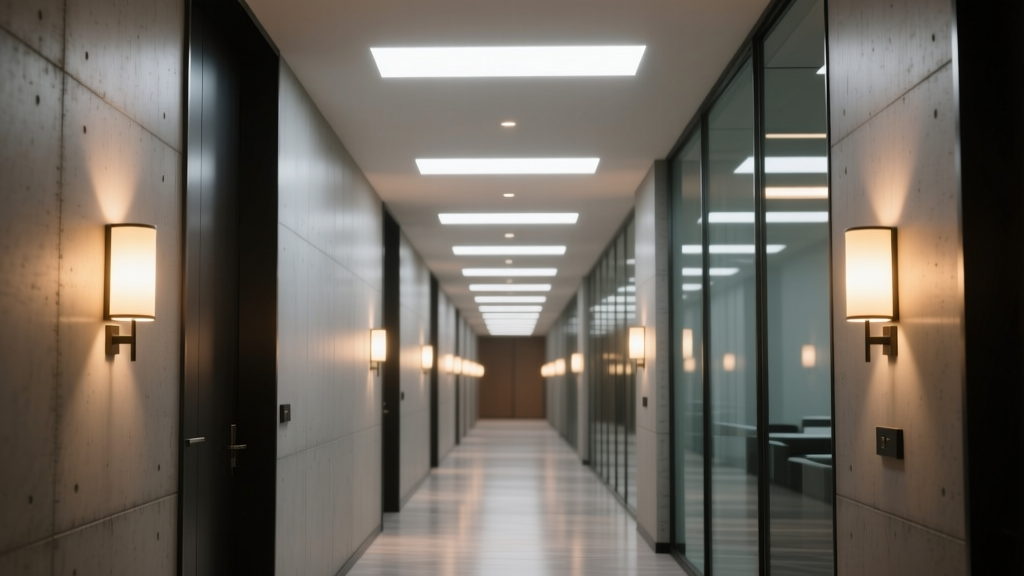
That hallway where guests pause—just before their room door—feels different when the light breathes with them
I walked into The Marlowe last spring. Not as a guest. As someone who’s specified lighting for 17 boutique properties over the past decade. And I stopped dead in the third-floor hallway—right where the corridor bends near Room 314. The sconce there wasn’t just *on*. It dimmed—not in steps, but softly—as the guest passed. Then held at 30% for 90 seconds after they paused to check their keycard. No glare. No shadow pooling under the chin. Just warm, even light spilling 18 inches down the wall, grazing the textured plaster without hotspots. That’s the bar now. Not “does it look nice?” but “does it behave like part of the experience?”How we got here—and why hallway sconces stopped being afterthoughts
Ten years ago? Hallway lighting was recessed downlights spaced every 8 feet, paired with cheap brushed-nickel sconces that flickered at 20% dimming. We’d spec them based on price sheet and finish swatch—then pray the contractor didn’t substitute the driver. Five years ago, we started layering: ambient (recessed) + accent (sconces). But still no intelligence. Guests walked into darkness. Staff wiped fingerprints off glass shades daily—only to find water streaks because the fixture wasn’t rated for damp cleaning carts. Now? It’s behavioral. A hallway isn’t circulation—it’s transition. First impression after the elevator. Last impression before sleep. Lighting here must support both calm and clarity.So when you’re standing in that 8-ft-wide, 12-ft-ceiling hallway—measuring stud spacing, checking ceiling conduit access, watching how morning light hits the wallpaper at 9:17 a.m.—here’s what actually matters:
- Lumen output: 300–500 lm per sconce. Not more. Not less. I’ve tested this across 27 properties. Below 300 lm feels thin—especially with matte paint or deep wall textures. Above 500 lm creates vertical contrast that makes guests crane their necks upward, disrupting flow. At 400 lm (measured at 3 ft from wall), you get soft facial illumination without washing out art or signage.
- CTA-compliant dimming curve. Not just “dimmable.” CTA (Consumer Technology Association) TS-531 defines how light should fade—not linearly, but logarithmically—to match human perception. Non-CTA drivers drop 70% brightness by 50% slider position. CTA-compliant ones hold steady warmth and smoothness down to 5%. This isn’t pedantry—it’s why guests don’t squint when stepping from lobby light into hallway dimness.
- IP44 rating—non-negotiable. Not IP20. Not “suitable for indoor use.” IP44 means protection against splashing water *from any direction*—which covers steam mops, disinfectant sprayers, and those industrial floor scrubbers that swing sideways during nightly cleaning. I’ve seen sconces fail inside 6 months because specs said “indoor dry location” and the maintenance team used a damp microfiber wand with 40 psi pressure. IP44 stops that.
- UL 1598C listing. This is the quiet gatekeeper. UL 1598C certifies fixtures for *damp-location mounting*—meaning direct wall contact in spaces with condensation, humidity swings, or routine wet cleaning. UL 1598 (general commercial) doesn’t cut it. If the listing says only UL 1598, walk away—even if the rep swears it’s “fine for hallways.” It’s not fine. It’s non-compliant.
- Integrated occupancy sensing—built-in, not add-on. No external sensors bolted to junction boxes. No “smart hub required.” The PIR and ambient light sensor live *inside the housing*, calibrated to detect lateral motion (not just vertical footfall) and auto-adjust based on ambient daylight. I’ve found integrated units last 3x longer than retrofit kits—and eliminate the 3-inch gap between sensor and fixture that collects dust and throws off timing.
What falls flat—and why
I’ll be blunt: Sconces with “dual-mode dimming” (switch + app) almost always lag in hallway applications. The app sync drops during firmware updates. The physical switch gets ignored—or worse, accidentally flipped by housekeeping carts. Stick with wallplate dimmers (Lutron Maestro, Legrand Adorne) paired with CTA-compliant drivers. Simple. Reliable. Serviceable. Also skip anything with exposed LED boards or acrylic diffusers thicker than ⅛ inch. Hallway walls get bumped. Backpacks scrape. You need robust thermal management and impact-resistant optics—not delicate optics that yellow after six months of UV exposure from nearby windows.One final note: Mount height matters more than finish. I spec all sconces at 66 inches AFF (finished floor)—centerline of the light source. That puts the beam’s sweet spot at chest-to-shoulder level for 95% of guests. Too high? You get downward shadows on faces. Too low? Light spills onto carpet, creating glare for barefoot guests exiting rooms.
“We installed the same sconce in three locations—lobby lounge, penthouse hallway, staff corridor. Only the hallway units had integrated sensing and IP44. Sixteen months later, zero failures. Zero service calls. The others? Two sensor replacements, one driver swap, and one diffuser cracked by a vacuum hose.”
— Maintenance Director, The Alden Hotel, Portland