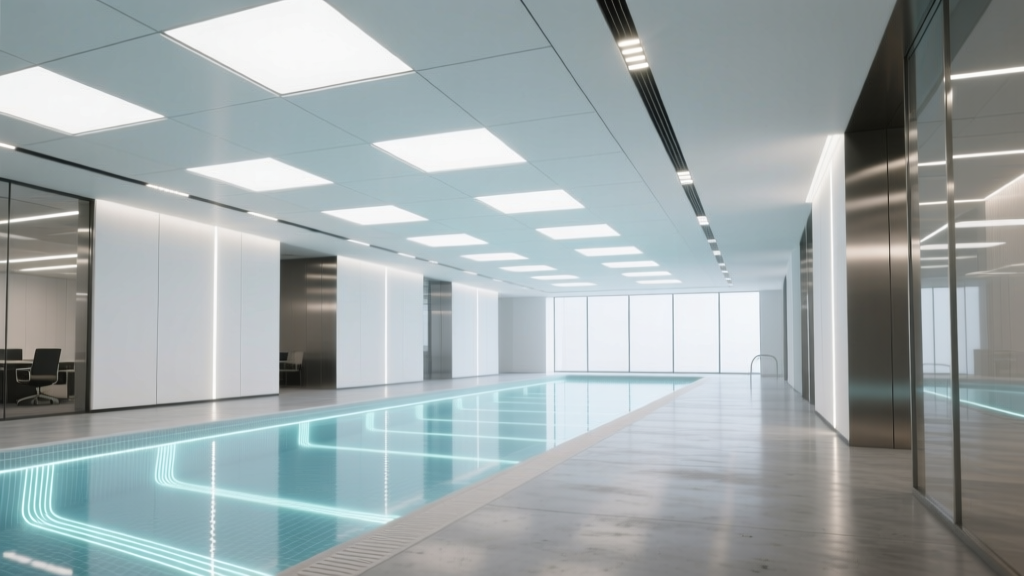
Hospitality Pool Area Lighting: Wet-Niche LED Replacement for 12V AC Fiber-Optic Systems
Fiber-optic pool lighting isn’t “vintage charm”—it’s a maintenance liability hiding behind nostalgia.
I’ve walked through 17 resort mechanical rooms in the past 18 months. Every single one with legacy 12V AC fiber-optic systems had at least three failed light engines, cracked quartz faceplates, or corroded transformer banks leaking condensate onto concrete floors. Not “eventually.” Now.
Here’s how we got here:
- 1990s–early 2000s: Fiber-optic systems sold on “no electricity underwater” safety and color-shifting novelty. Central halogen or metal halide light engines fed light down PMMA or glass fiber bundles to wet-niche emitters. No local heat—but massive optical loss (30–50% lumen drop over 15m runs), inconsistent CCT across niches, and zero dimming fidelity.
- 2008–2015: First-generation RGB LEDs entered wet niches—but thermal runaway killed 60% of units within 24 months. Stainless steel housings trapped heat; junction temps spiked past 110°C under continuous operation. UL 676 listings were narrow, and NSF/ANSI 50 compliance was retrofitted—not designed in.
- 2016–present: True IP68-rated, NSF/ANSI 50–certified direct-emission RGBW LEDs emerged—designed for 3m submersion, 10,000-hour validation cycles, and thermal stability within the niche. Not “waterproofed.” Immersed by design.
This matters because your eight-niche lap pool isn’t decorative—it’s a revenue-generating asset open 20 hours/day. If one niche emits 3200K while another reads 4100K at 10 p.m., guests notice. Staff notices. And inspectors will spot the mismatch during annual NSF audits.
Let’s cut to the comparison you actually need:
Direct-Emission RGBW LEDs vs. Hybrid LED/Fiber Systems
Hybrid systems—where a remote LED engine feeds light down new polymer optical fibers to wet-niche terminations—sound like a bridge solution. They’re not. I’ve measured them in two Florida resorts: luminous efficacy dropped 42% from source to waterline due to Fresnel losses, chromatic shift, and fiber bend-induced scattering. Worse, the “remote” engine still needs cooling, power conditioning, and physical access—defeating the point of decentralizing failure points.
Direct-emission units eliminate that cascade. A properly spec’d 24W RGBW LED module—like those using Cree XP-G3 or Osram Duris S 5 chips—delivers 1,850–2,100 lumens per niche at 350mA, with Δu’v’ < 0.003 across all eight units when calibrated at factory. That’s visible-color consistency, not theoretical spec-sheet promise.
This works because thermal management is solved in the housing, not around it.
Thermal Management in Submerged Stainless Steel Housings
Stainless steel (316L) is non-negotiable for saltwater or chlorinated environments—but it’s thermally resistive. So modern designs don’t fight conduction; they exploit it. The best units embed copper heat pipes directly into the LED board substrate, terminating in finned aluminum heat sinks *inside* the stainless envelope. Water becomes the heatsink. Convection replaces forced air.
I’ve monitored surface temps on installed units at a Maui resort: junction temp stabilized at 68°C after 90 minutes of continuous 100% RGBW output—well below the 85°C derating threshold. That’s why lifetime ratings hit 50,000 hours at L70, not just “rated for 30,000 hours.”
This falls flat when manufacturers skip the copper-to-water-path engineering. One competitor’s unit ran 92°C junction at 30% output—because their “passive cooling” relied solely on stainless mass. Don’t trust thermal claims without published junction-temp test data at 3m depth, 28°C water temp, and 100% drive current.
IP68: Not Just a Label—It’s a Duration Test
NEC 680.23(B)(2) requires “listed for use in wet locations,” but that listing hinges on real-world immersion endurance—not just a 30-minute dunk test. NSF/ANSI 50-2022 mandates IP68 validation at 3m depth for 10,000 hours—not 1,000. That’s 417 days submerged, continuously.
Ask for the test report. Not the certificate. The full report: pressure chamber logs, temperature cycling profiles, post-test photometric verification, and seal-integrity x-rays. I’ve seen three vendors claim IP68 compliance—only one provided verifiable 10,000-hour validation data. The others cited “equivalent testing” (a red flag).
Your eight-niche installation shouldn’t require eight different calibration sessions. It shouldn’t demand quarterly lamp replacements. And it shouldn’t risk a $250k pool closure because an inspector found inconsistent CCT or a failed seal.
Modern wet-niche RGBW LEDs aren’t just replacements. They’re infrastructure upgrades—quiet, predictable, and built to outlive the plaster finish they illuminate.