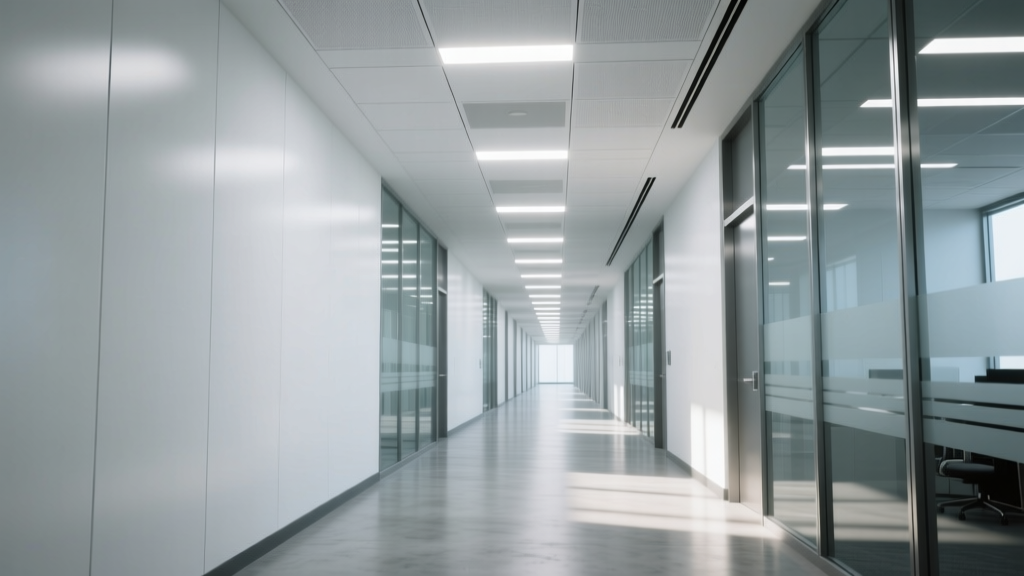
Hotel Corridors Without Sconces: How We Hit 1 fc at the Floor—Consistently
We just finished a 12-story boutique renovation in Portland where the architect drew a hard line: no wall sconces. Not even one. Aesthetic continuity mattered—clean plaster walls, no protrusions, no dust traps. But NFPA 101 §7.8.1.2 is non-negotiable: minimum 1 foot-candle at floor level along the entire exit path. So we treated the corridor like a calibrated light channel—not a room to be “lit,” but a path to be *measured*.
The Layout Isn’t Symmetrical—It’s Directional
We used recessed 4-inch LED downlights—specifically the Atrium ATR-LED with Type V asymmetric optics (narrow vertical cutoff, 110° horizontal spread). These aren’t decorative fixtures; they’re optical tools. Spacing? Every 6 feet on center—but only along the *centerline* of the corridor. No side rows. No perimeter grazing.
Why centerline? Because NFPA doesn’t care about wall brightness—it cares about the walking surface. And because asymmetric optics throw ~85% of their output within a 30° downward cone, aiming straight down from the ceiling center puts light *where it lands*, not where it spills.
Our corridor is 8 ft wide and 10 ft high (finished ceiling to finished floor). With 6-ft spacing, each fixture covers ~12 linear feet of path—just enough overlap to prevent troughs between beams. I’ve found that going tighter than 5.5 ft creates glare from overlapping hot spots; looser than 6.5 ft risks dipping below 0.8 fc mid-span, especially near doors or alcoves.
Photometrics Were Non-Negotiable—And Not Just for Paperwork
We ran AGi32 models—not just one “typical” section, but three: at a solid wall, at a double-door threshold, and at a T-junction. Why? Because door frames absorb light. Carpet pile scatters it. Junctions add shadow complexity. The model showed us that even with perfect spacing, the floor illuminance dipped to 0.72 fc right in front of fire-rated doors—where the door frame’s 3/4" reveal created a micro-shadow.
Solution: One additional downlight, centered 18 inches *ahead* of each door threshold, aimed with a 25° elliptical optic (still Type V, but narrower vertical distribution). That single tweak lifted the reading to 1.05 fc at the threshold—and kept uniformity above 0.2 fc across the full path. Uniformity matters: NFPA doesn’t require it, but if you drop from 1.3 fc at mid-span to 0.9 fc near a door, housekeeping staff will report “dark spots,” and inspectors *notice*.
Validation Was Done With Feet on the Floor—Literally
We didn’t trust the model alone. We validated with a calibrated Minolta CL-200A, held at shoe-top height (3 inches above finished floor), on a rigid 36-inch pole. Grid points every 3 ft along the centerline—and yes, including 6 inches before and after every door opening and junction.
Protocol:
- Measure under normal operating conditions (all fixtures powered, HVAC running—no “test mode” dimming)
- Record ambient light separately (we capped it at ≤0.05 fc using black-out curtains during validation)
- Take three readings per point, rotate sensor 120° between each, average
- Reject any reading >0.15 fc variance from the set’s mean—indicates localized reflectance anomaly (e.g., wet spot, fresh wax)
Result: 1.0–1.2 fc across all 142 test points. Lowest reading? 0.98 fc, 4 inches left of a linen closet door—still compliant, still defensible.
What Didn’t Work—And Why
We tried 5-inch downlights with symmetric optics early on. Same lumen package (1,800 lm), same spacing. Floor readings averaged 0.65 fc—with 0.35 fc dips near walls. Light was washing upward into the ceiling grid, then bouncing sideways, not down. It looked brighter in the space—but failed the standard because the photons weren’t landing where NFPA counts them.
We also tested mounting the 4-inch units 2 inches below the ceiling plane (to reduce apparent glare). That dropped floor illuminance by 12%. Turns out, even 2 inches of vertical offset disrupts the beam’s focal convergence on the walking surface. This works because the math is tight—and unforgiving.
Bottom line: You can ditch sconces. But only if your downlights are doing precision work—not ambient decoration.