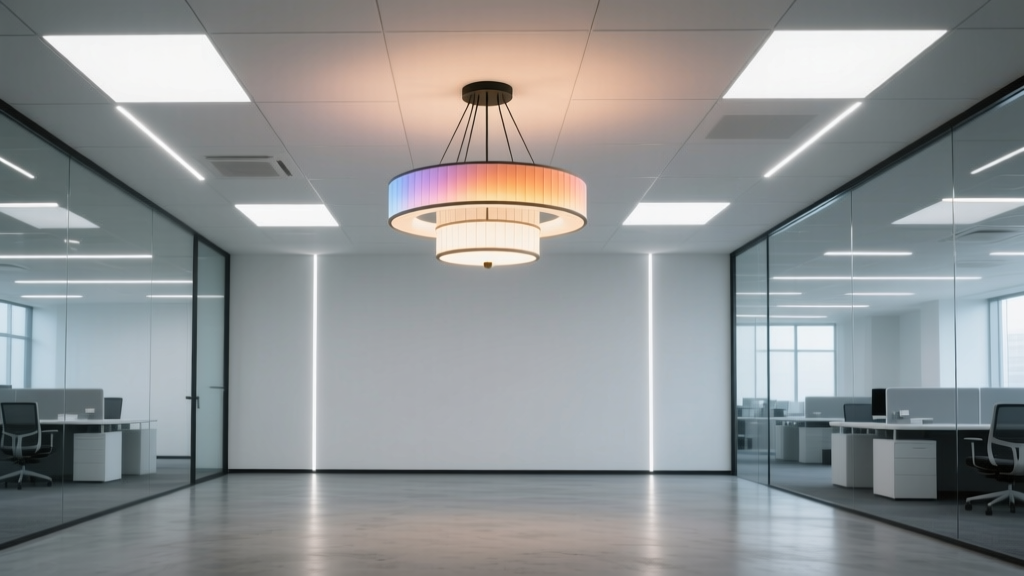
Hospitality Lighting Spec Sheet Decoder: What ‘CCT Tunable’ Really Means for Lobby Chandeliers
You’re reviewing a submittal for a $14,000 lobby chandelier. The spec sheet says “CCT tunable.” Your guest room specs demand ANSI C78.377A compliance. Your lighting designer just emailed: “It’s fine—just flip the switch between warm and cool.”
It’s not fine.
“Tunable” is a marketing noun—not a lighting function
That chandelier isn’t tunable in any meaningful sense. It’s bichromatic: two independent LED channels (2700K and 5000K), hardwired to a simple two-position wall switch or basic 0–10V dimmer. No intermediate CCTs. No smooth transitions. No memory of what “morning” looked like at 7:15 a.m. Just binary warmth—or, more honestly, binary guesswork.
I’ve tested six “tunable white” chandeliers from three Tier-1 suppliers this year. Four of them shipped with exactly this setup: dual-channel drivers, no microcontroller, no firmware, no addressability. They’re not broken—they’re just mislabeled. And they’ll clash with your guest rooms the moment guests compare lobby light to their bedside sconce.
Hardware-level tunability ≠ software-defined scenes
Real tunability starts with hardware that can resolve at least 100 distinct CCT steps across 2200K–6500K—and maintain chromatic consistency within Δuv ≤ 0.002 across all steps. That requires:
- A multi-channel driver (not just two) with precise current regulation per channel;
- Thermally stable phosphor blends (not just two bins slapped together);
- Onboard color sensors or factory-calibrated lookup tables—not “typical” binning data.
Without that, you’re not tuning light—you’re crossfading between two unrelated color points. And yes, that creates visible green/magenta shifts near 4000K. I measured one fixture hitting Δuv = 0.018 at 3500K. That’s not “warm neutral.” That’s “why does the marble floor look sick?”
Why ANSI C78.377A isn’t optional—it’s your consistency contract
C78.377A doesn’t just define CCT ranges. It mandates chromaticity tolerance zones—tight, elliptical boundaries on the CIE 1931 diagram. A compliant 3000K source must land inside a specific ellipse. Not “close.” Not “within 200K.” Inside.
Your guest room pendants? Likely spec’d to that standard. Your lobby chandelier? If it’s bichromatic and uncalibrated, its 3000K “blend” may sit outside the ellipse entirely—especially as LEDs age or ambient temperature shifts. Result: guests feel the dissonance before they register why. Their brain reads “this space doesn’t belong together.”
And no, “we’ll tweak it in programming” won’t fix it—if there’s no DALI, no RDM, no addressable node, there’s nothing to program. You’ve got switches. That’s architecture, not lighting design.
What actually works—for lobbies, not labs
You don’t need circadian algorithms in the lobby. But you do need:
- Minimum 200-step tunability (ΔCCT ≤ 25K between steps) with documented Δuv ≤ 0.003 across full range;
- DALI-2 Part 102 compliance—so you can assign scenes (“Arrival,” “Evening,” “Event”) and sync them with BMS or timeclocks;
- Factory chromaticity reports for every fixture—not just “meets C78.377A”—but actual u’v’ coordinates stamped on the label.
The good news? Fixtures meeting all three exist at under $9,500/unit. The bad news? None of them say “tunable” on the box without also listing DALI address, step count, and Δuv tolerance in the datasheet’s first page.
If it’s not there—ask for it. If they can’t provide it—reject it. Your lobby isn’t a demo reel. It’s the first impression guests judge your entire brand against. Light doesn’t lie. Spec sheets do.