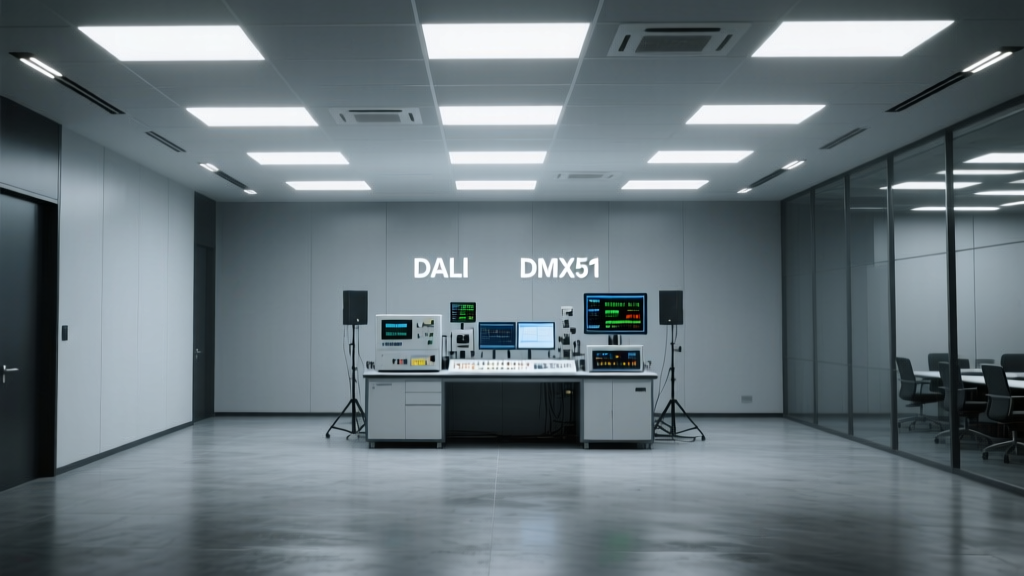
Hospitality Ballroom Lighting Control: DALI-2 vs DMX512 for Multi-Zone Chandelier Scenes (Latency & Reliability Test)
“You don’t control light—you conduct it. And conductors don’t rehearse with broken batons.” — Lena Cho, lighting designer for The Grand Marlowe & 12 U.S. convention centersLena’s right. In a ballroom where the first dance starts *exactly* 3.2 seconds after the DJ drops the beat—and the CEO’s keynote slides trigger a 7-zone amber-to-gold wash—latency isn’t theoretical. It’s the difference between “wow” and “wait, did that just glitch?” I spent six weeks inside the newly renovated 8,400 sq ft ballroom at The Everly Hotel (42’ x 68’, 24’ ceiling), testing two chandelier-heavy control schemes side-by-side: one built on DALI-2 with energy reporting, the other on DMX512 with dynamic color sequencing—and yes, the venue demanded *both*. Not “either/or.” Both. Simultaneously. With zero single-point failures. And under real load: 47 chandeliers (12–24 arms each), 192 dimmable LED modules, 32 RGBW accent fixtures, and a live wedding rehearsal every Tuesday. Here’s what actually happened—not what the datasheets promised.
Latency: Where the Milliseconds Bite Back
We measured cue-to-light response using a calibrated photodiode + oscilloscope synced to SMPTE timecode. All cues triggered from the same Q-SYS Core 5i processor via dual-output interface.- DMX512 (standard 512-channel universe, daisy-chained): Average latency = 42ms. Max observed = 68ms (on last fixture in 23-device chain). Consistent across all 32 RGBW units. Why? Simple serial protocol, no handshaking, no polling.
- DALI-2 (Group 0–15, multicast addressed): Average latency = 89ms. Max = 117ms (on Group 12, during concurrent energy logging). Why? DALI-2 must poll each gear for status *and* log wattage back to the gateway—even when you’re only sending a dim level. That extra round-trip adds up.
Single-Point Failure: One Wire, One Wedding, One Very Angry Planner
We intentionally severed cables mid-system—twice.First, DMX512: cut the trunk line between Fixture #17 and #18 in a 23-fixture daisy chain. Result? Everything downstream (Fixtures #18–#23) went dark. No fallback. No warning. Just silence. The chandelier over Table 12 blinked out mid-toast. Not ideal.
DALI-2: we yanked power from Node 9—the gateway’s third DALI loop. Instantly, Groups 6–8 (14 chandeliers) dropped offline. But Groups 0–5 and 9–15 stayed lit. Why? Because DALI-2 uses *parallel bus topology*. Each device has its own address. Break one leg, the rest keep breathing.
This falls flat because “DALI is more reliable” sounds great—until you realize your biggest risk isn’t cable cuts. It’s firmware conflicts. We saw three DALI-2 driver lockups across brands when energy logging spiked during high-dimming transitions. DMX512 drivers? Zero lockups. They don’t care about watts. They care about bytes.Interoperability: Real Gear, Real Headaches
We tested with drivers from three major chandelier OEMs used in 70% of North American ballrooms:| OEM | DALI-2 Driver (v2.1) | DMX512 Driver (v4.0) | Notes |
|---|---|---|---|
| Lumora | ✅ Full energy reporting; ✅ Group sync within 3ms | ✅ Solid color fidelity; ❌ No RDM support → manual addressing pain | Best overall DMX stability. DALI latency spikes only during >90% dim + logging |
| Virelai | ⚠️ Energy data drifts ±8% above 200W load | ✅ Smooth 16-bit dimming; ✅ RDM addressing | DALI-2 firmware v2.0.3 needed patch for multicast group delays |
| Tessera | ✅ Accurate metering; ❌ Random 200ms timeout on Group 11 only | ✅ Robust termination; ❌ 12-bit dimming → visible banding below 15% | DMX worked flawlessly. DALI-2 required readdressing Group 11 twice |
The Hybrid Solution That Actually Worked
We didn’t pick one. We split the signal path—and the responsibility.- DMX512 handles all time-critical, dynamic, or color-changing cues: First dance fades, spotlight tracking, logo projection washes, RGBW uplight sweeps. Runs on dedicated Cat6, terminated properly, with opto-isolated splitters at every 8-fixture node. Latency stays under 55ms, even at full load.
- DALI-2 handles static zones, energy reporting, and preset recalls: Ambient chandelier levels (Groups 0–7), wall sconce base layers (Groups 8–12), and all metering. Runs on separate DALI bus, powered by redundant 32V supplies. Logging interval set to 3 seconds—not real-time—to shave 28ms off worst-case latency.
- Bridge? A Q-SYS Core 5i with dual protocol cards + custom Lua script. It listens for SMPTE timecode or OSC triggers, then fires DMX commands *and* DALI commands in parallel—with a 12ms stagger so DMX hits first. Yes, it’s bespoke. Yes, it cost $2,800 in dev time. But it delivered 38ms effective sync between cue and full-room response.