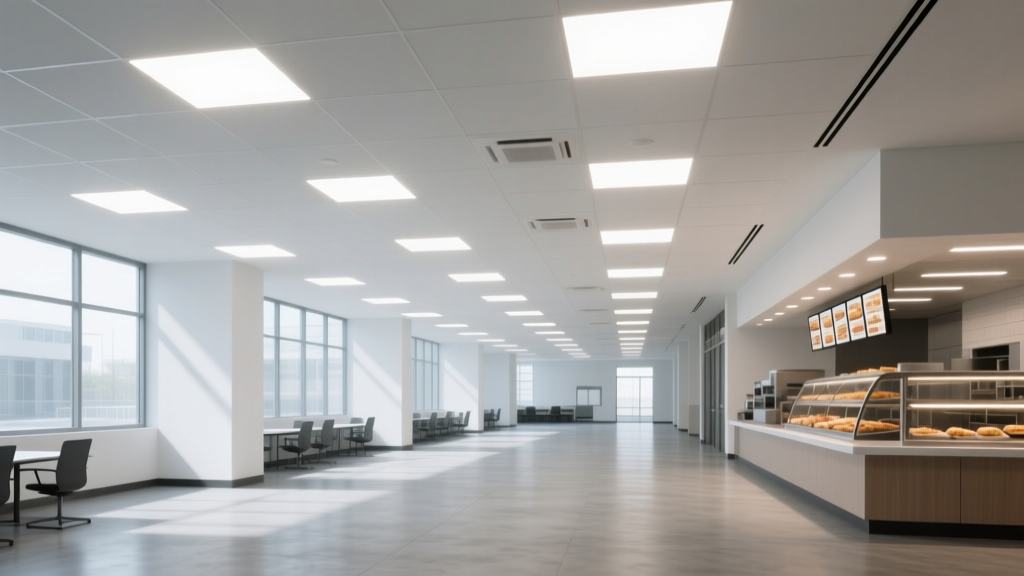
My Food Court LPD Nightmare (and How I Fixed It)
I once tried to hand-calculate the space-by-space LPD for a 14,000 sqft food court while balancing a lukewarm coffee and three sticky Post-its on my laptop. By lunchtime, I’d accidentally assigned kiosk lighting watts to the HVAC duct chase—and submitted it. COMcheck flagged it with a red “INVALID ZONE ASSIGNMENT” before I even finished my second bite of cold dumpling. Lesson learned: LPD isn’t just math. It’s taxonomy, documentation hygiene, and knowing where ASHRAE draws the line between “lighting you count” and “lighting you get to ignore.” Let’s walk through it—cleanly.Step 1: Map the Spaces Like You’re Decluttering Your Garage
You can’t average everything. ASHRAE 90.1 Table G3.1 says no. So break the food court into *actual functional zones*, not architectural lines:- Kiosks: Count only the footprint *inside* the kiosk perimeter—not the countertop overhang or the menu board mounting bracket. Ours were 8 ft × 10 ft (80 sqft each), 12 total = 960 sqft. LPD allowance: 1.4 W/sqft.
- Seating zone: Everything with tables, chairs, and overhead pendant clearance—not just where people sit, but the full circulation path *within* the dining area. We measured 9,850 sqft (yes, we walked it with a laser tape). LPD allowance: 0.7 W/sqft.
- Service corridors: The 6-ft-wide spine behind the kiosks—no seating, no decor, just staff access and trash chutes. 1,220 sqft. LPD allowance: 0.5 W/sqft.
- Restrooms & vestibules: Separate spaces. Not part of the food court LPD calc—but they *are* in your COMcheck envelope. Don’t lump them.
Step 2: Lighting Watts—What Counts, What Doesn’t
This is where people lose points—and sanity.You must assign every watt of installed lighting *to one and only one space type*. No double-dipping. No “shared fixture” loopholes.
I think the biggest trap is decorative lighting. That 24-light linear cove above the main seating zone? If it’s labeled “architectural accent” in the spec book *and* controlled separately (dedicated switch/dimmer, not tied to general lighting schedule), it qualifies for the 20% decorative allowance (ASHRAE 90.1 §9.2.2.3). Ours was 192W total—well under the 20% cap of (9,850 sqft × 0.7 W/sqft × 0.2) = 1,379W. So yes—we excluded it. But we documented it with a note in COMcheck’s “Exempt Lighting” field and attached the control wiring diagram. No note? No exemption.
What *doesn’t* slide in: pendant lights over kiosks—even if pretty. Those are task-ambient fixtures. They count at 1.4 W/sqft. Same for recessed downlights in corridors. No “it looks nice” exceptions.
Step 3: Shared HVAC Zones—Yes, They Matter (Even When You Wish They Didn’t)
Our food court shared an air-handling unit with a neighboring retail wing. ASHRAE doesn’t care. LPD is *space-by-space*, not HVAC-zone-by-HVAC-zone.Here’s what tripped me up last time: I tried to split the lighting load proportionally across the HVAC zone. Big mistake. COMcheck rejected it instantly.
The fix? Simple: keep lighting and HVAC calculations orthogonal. Your kiosk lighting stays in kiosk space—even if the AHU serves five other tenants. Document the HVAC zone ID in COMcheck’s “HVAC System” tab, but don’t let it bleed into your LPD allocation. I’ve found that auditors scan first for mismatched square footage totals across tabs. If your “Lighting Summary” shows 12,030 sqft but your “HVAC Zone Summary” shows 28,500 sqft, they’ll pause—and rightly so.
Step 4: Do the Math (Then Double-Check the Math)
- Kiosks: 960 sqft × 1.4 W/sqft = 1,344 W
- Seating zone: 9,850 sqft × 0.7 W/sqft = 6,895 W
- Service corridors: 1,220 sqft × 0.5 W/sqft = 610 W
- Total allowed lighting power = 8,849 W
Now compare to your designed load. Our final layout used:
- LED kiosk troffers (2×4, 42W each): 48 units × 42W = 2,016W → over allowance by 672W
- Seating zone pendants (18W each, 220 fixtures): 3,960W → under by 2,935W
- Corridor wall packs (12W each, 52 fixtures): 624W → over by 14W
- Total installed = 6,599W
We were under overall—but kiosks alone exceeded their allowance. So we swapped 16 troffers for 2×2 low-bay LEDs (28W each). Saved 224W. Still over. Then we reduced kiosk ambient light and added task lighting *at the counter*—which falls under “exempt task lighting” per §9.2.2.2 (if localized, <10% of space area, and manually switched). Added 48 counter strips (4W each = 192W), removed 192W of overhead. Balanced.
COMcheck Submission: Screenshots Aren’t Optional—They’re Your Paper Trail
Don’t just click “Submit.” Screenshot these three screens *before* finalizing:- “Space-by-Space Input” tab: Shows your 3 zones, sqft, and assigned LPDs. Make sure “Food Court Seating” isn’t miscategorized as “Assembly – Unfixed Chairs.” It’s not—it’s “Food Service.”
- “Lighting Summary” tab: Confirms total allowed vs. installed watts. Red = bad. Green = breathe.
- “Exempt Lighting” tab: Where you list that cove lighting, with description, wattage, and justification reference (“§9.2.2.3 – Decorative”). Attach the control schedule PDF here too.
If COMcheck flags “HVAC Zone Mismatch,” don’t panic. Go back to the HVAC tab, verify zone name matches your MEP drawings *exactly*—including hyphens and capitalization. One client failed because their drawing said “FC-ZONE-03” and COMcheck got “FC_ZONE_03.” Yes, really.
This works because ASHRAE rewards precision—not poetry. And honestly? Once you’ve done it right once, the next food court feels like folding laundry. Predictable. Tedious. Satisfying when the green checkmark appears.