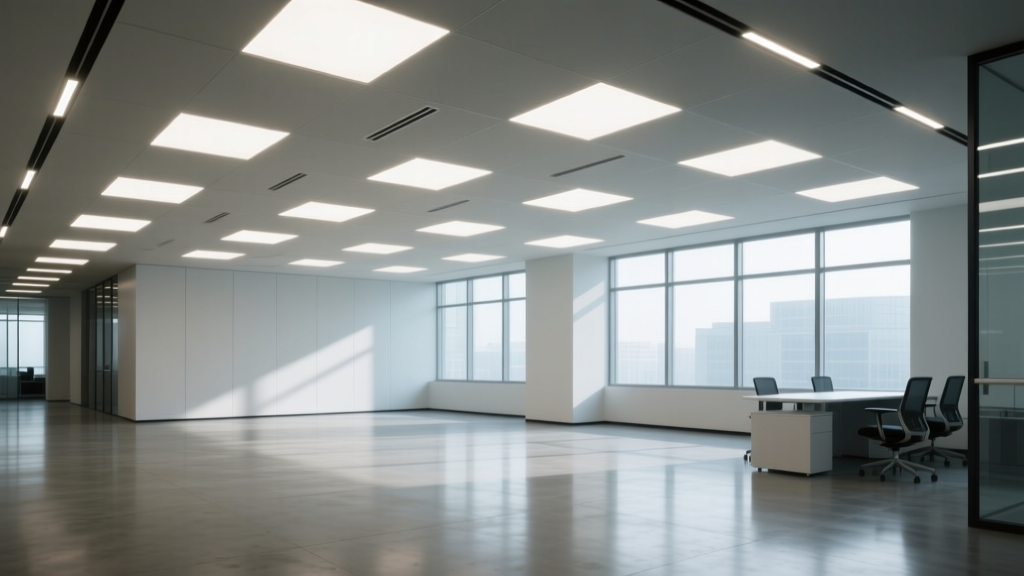
DLC Premium doesn’t mean “plug-and-play compliant” — it means “your fixture passed a lab test.” That’s it.
Here’s what I hear at least twice a week on job sites, in plan reviews, and over coffee with lighting reps: “It’s DLC Premium—so it *has* to meet IECC 2021. We’re good.”
Nope. Not even close.
I’ve seen architects stamp drawings with DLC-stamped specs—only to get the plan rejected by the AHJ because the total installed wattage in a conference room blew past 0.75 W/sqft. I’ve watched contractors rip out $18,000 worth of “fully compliant” LED troffers after the energy model came back red-flagged—not because the fixtures were bad, but because no one added up the watts *per space type*, applied the right allowances, or accounted for controls integration.
Let’s clear this up once and for all: DLC qualification is about fixture performance—not building energy compliance. It’s a product-level certification, not a project-level pass. And IECC 2021 (which adopts ASHRAE 90.1-2019 by reference) doesn’t care how efficient your individual luminaire is. It cares how much power your *entire lighting system* draws in each defined space—and whether that number falls under the hard-wired LPD limits in Table G3.1.
What DLC actually certifies (and what it ignores)
DLC evaluates luminaires against specific photometric, thermal, and electrical criteria: lumen maintenance (L90 at 6,000+ hours), minimum efficacy (≥130 lm/W for most indoor types), power quality (THD < 20%, PF ≥ 0.9), and reporting transparency (LM-79, LM-80, TM-21). Great stuff. Necessary stuff.
But nowhere in DLC’s 47-page Technical Requirements v6.1 does it ask:
- How many fixtures are you installing per square foot?
- Are they controlled by occupancy sensors? Dimmed? Grouped correctly?
- Is there task lighting—and if so, is it exempted properly?
- Does your open office include a dedicated print/copy zone? A huddle room? A wellness lounge? Each has its own LPD cap.
DLC tests one unit, in one configuration, on one optical bench. It doesn’t simulate your floor plan. It doesn’t know your ceiling height is 11’6”, your wall finishes are matte black, or your daylight harvesting sensors are set to 35% dim-to level. Those details—the ones that make or break code compliance—live in your lighting design, not your spec sheet.
IECC 2021 doesn’t look at fixtures. It looks at spaces.
IECC 2021 Section C405.2.1.1 says it plainly: “Lighting power shall not exceed the values specified in Table C405.2(1) [i.e., ASHRAE 90.1 Table G3.1] for the space being lit.” Note: “for the space being lit.” Not “per fixture.” Not “per circuit.” Not “on average across the floor plate.”
That table breaks down LPD allowances by space function, not by luminaire type. For commercial offices, here’s what matters:
| Space Type | IECC 2021 LPD Limit (W/sqft) | Notes & Exceptions |
|---|---|---|
| Open office (general) | 0.95 | Applies to unenclosed work areas ≥ 100 sqft; includes circulation paths within the zone |
| Private offices (≤ 250 sqft) | 1.15 | Only if fully enclosed, with walls ≥ 5’ high and door; excludes vestibules |
| Conference rooms | 0.75 | Includes built-in AV; no task lighting allowance unless permanently installed and independently switched |
| Breakrooms/kitchens | 0.85 | Excludes refrigeration, cooking, or exhaust lighting |
| Corridors | 0.55 | Must be controlled separately; occupancy sensing required |
Now—here’s where things go sideways in practice.
Say you’re lighting a 12,000-sqft speculative office floor. Your architect calls for a uniform grid of DLC Premium 2×4 edge-lit troffers—each drawing 32W, delivering 4,200 lumens, and rated at 131 lm/W. Solid performer. Looks great on paper.
You install them at 9’-0” on-center—roughly 1 fixture per 81 sqft. Do the math: 32W ÷ 81 sqft = 0.395 W/sqft. Way under 0.95. You breathe easy.
Then the energy model comes back—and fails.
Why? Because your “open office” area isn’t just workstations. It includes a 600-sqft huddle room (LPD limit: 0.75), a 450-sqft copy/print zone (LPD limit: 1.15—but only if labeled as “support space” per Table G3.1 footnote 2), and a 220-sqft wellness lounge (LPD limit: 0.85). Your uniform grid dumped the same 32W troffer into *all* those zones—even though the huddle room only needs half the light level and should use lower-wattage, dimmable pendants.
The model doesn’t average across the floor. It sums watts *by space*, then compares each sum to that space’s specific LPD cap. Your huddle room used six 32W troffers (192W) in 600 sqft = 0.32 W/sqft—technically fine—but now your copy zone has eight troffers (256W) in 450 sqft = 0.569 W/sqft, which sounds safe… until you realize Table G3.1 allows **1.15 W/sqft** *only if* that space is explicitly classified as “office support space” *and* you document it as such in the construction documents. If you called it “corridor adjacent” or didn’t call it out at all? The default is general office: 0.95. Still okay. But if the reviewer classifies it as “equipment room” (LPD limit: 1.40), you’re golden—or as “storage” (LPD limit: 0.25), you’re cooked.
Classification drives compliance—not lumens per watt.
Task lighting isn’t “bonus light.” It’s a calculated exemption—if you do it right.
This is where even experienced designers slip up. ASHRAE 90.1 Table G3.1 footnote 3 permits subtracting *up to* 10 W per workstation for “task lighting that is permanently installed and independently switched from the general lighting.”
Key words: permanently installed, independently switched.
A plug-in LED desk lamp? Doesn’t count. A USB-charged under-cabinet bar mounted with double-stick tape? Nope. A hardwired, DALI-addressable LED task light with its own wall switch or app-controlled channel? Yes—if you document the circuit separation and control logic.
I recently reviewed a set of drawings where the designer specified “DLC Premium under-cabinet task lights” above every workstation. Great idea—except they were wired to the same branch circuit as the overhead troffers and controlled by the same vacancy sensor. The AHJ rejected the entire task-lighting allowance. Zero watts subtracted.
So let’s run numbers. Say your open office is 10,000 sqft, with 125 workstations (80 sqft each). You install:
- 125 DLC Premium 2×2 troffers @ 24W each = 3,000W
- 125 hardwired, independently switched task lights @ 9W each = 1,125W
Without task allowance: 3,000W ÷ 10,000 sqft = 0.30 W/sqft → well under 0.95.
With proper allowance: subtract 10W × 125 = 1,250W → adjusted general lighting load = 3,000W − 1,250W = 1,750W → 1,750W ÷ 10,000 sqft = 0.175 W/sqft.
That’s not just compliant—it gives you headroom to add accent lighting, upgrade to higher-CRI sources, or invest in better controls without hitting the cap.
But—and this is critical—the allowance only applies to the *general lighting circuit*. You still have to power and control the task lights. They don’t reduce your total connected load; they shift accountability. And if your task lights draw more than 10W each? Too bad. The cap is fixed. You can’t “bank” unused watts from one station to boost another.
Controls aren’t optional extras—they’re LPD multipliers.
IECC 2021 doesn’t just cap watts. It mandates *how* you deliver them. Section C405.2.2 requires automatic shutoff in almost every interior space—and for good reason: a 0.95 W/sqft design with no controls will use more energy than a 1.15 W/sqft design with full dimming, scheduling, and daylight harvesting.
Here’s what gets missed: LPD limits assume controls are in place. Table G3.1 footnote 1 states: “The lighting power densities in this table are based on the assumption that the lighting system is controlled in accordance with Section C405.2.2.”
In plain English: if you skip occupancy sensors in private offices, or omit daylight dimming in perimeter zones, your *effective* LPD limit drops—sometimes by as much as 10–15%. Some jurisdictions enforce this strictly. Others won’t flag it until commissioning.
I think this is where the industry’s “DLC = compliant” myth really unravels. A DLC Premium fixture might have a 0–10V dimming input—but if the contractor wires it straight to line voltage and leaves the potentiometer at 100%, that fixture is now operating at *maximum output*, regardless of ambient light or occupancy. You haven’t reduced LPD—you’ve just bought expensive hardware you’re not using.
Real-world example: A 20,000-sqft law firm retrofit. They chose DLC Premium 3-ft 4K LED wraparound fixtures (38W, 5,100 lm). Installed at 10’-6” centers = ~1 fixture/110 sqft = 0.345 W/sqft. Sounds perfect for private offices (1.15 cap).
But—no vacancy sensors were installed. No bi-level switching. No daylight zoning. The engineer stamped it anyway. Then the commissioning agent walked in, flipped the switch, and measured 38W per fixture, 100% of the time. Total connected load: 0.345 W/sqft. Total *energy use intensity*: nearly double what the model predicted.
The fix? Not new fixtures. Just adding occupancy sensors + grouping into 2–3 circuits per room. Cost: $1,200. Time: one afternoon. Result: 42% reduction in lighting energy use—without changing a single luminaire.
So what *does* guarantee IECC 2021 compliance?
Nothing does—absolutely guaranteed. But here’s what gets you there, consistently:
- Classify every space before selecting fixtures. Don’t say “office.” Say “private office, 14’×16’, full-height walls, door with closer, no windows.” Then go to Table G3.1 and pull the exact LPD cap.
- Calculate watts per space—not per fixture or per floor. Use CAD layer counts or takeoff software that tags fixtures by room name/number. Export to Excel. Sum watts. Divide by gross area. Compare.
- Treat task lighting like a line item—not an afterthought. Specify mounting, wiring, switching, and control protocol *in the lighting legend*, not the notes. Include circuit schedules that show independent breakers.
- Model controls as part of the LPD calculation. If daylight sensors are specified, confirm the dimming range (e.g., 0–100% or 10–100%). If vacancy sensors are required, verify the timeout setting (5 min? 20 min?) and whether manual-on is allowed.
- Get the DLC sticker—but read the fine print. DLC Premium tells you the fixture *can* comply—not that it *will*. Check the DLC Product Finder for “IECC 2021 Ready” filters? There is none. DLC doesn’t rate for code. Don’t let sales reps imply otherwise.
Bottom line: DLC is a tool. A very good one. But it’s a wrench—not the blueprint.
I’ve walked too many sites where the “compliant” lighting package failed inspection because someone trusted a label instead of doing the math. Don’t be that person. Pull Table G3.1 off the IECC website. Print it. Tape it to your monitor. And next time someone says, “It’s DLC Premium, so we’re fine”—hand them the table and say, “Great. Now tell me which space type this fixture is in—and what your total watts per square foot are for *that* space.”
That’s how real compliance starts.