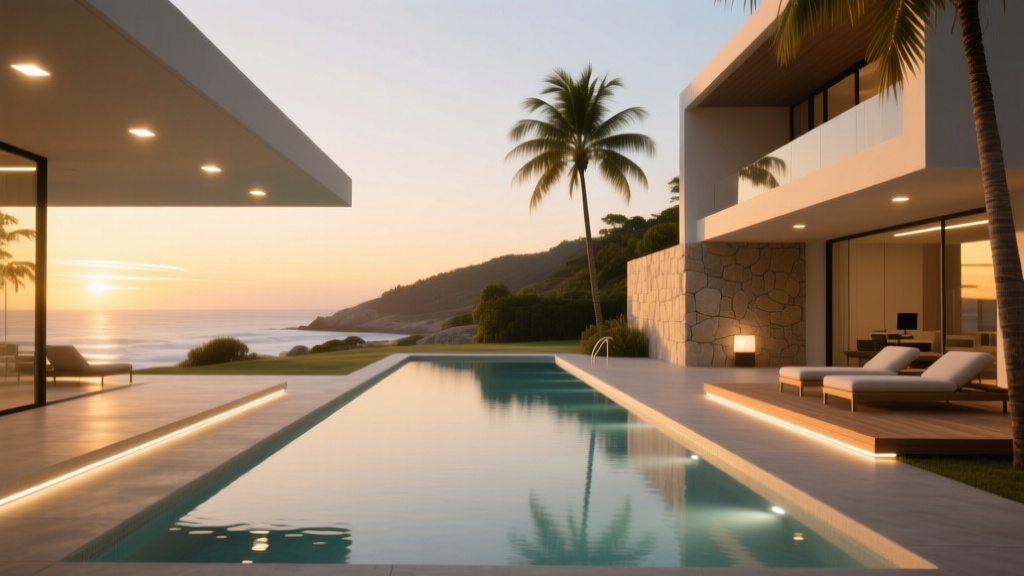
Hospitality Lighting Case Study: Reducing Nighttime Light Trespass in Coastal Resort Pool Area
You step onto the pool deck just after sunset — not at 7:01 p.m., but right as the last amber light bleeds from the western horizon. The air is salt-tinged and still. No glare stings your eyes. No pool light spills onto the dunes or blinks through neighbor’s bedroom windows. Instead, you see only soft, even pools of light along the walkway — precise, grounded, intentional. That’s not luck. That’s the result of a six-month lighting recalibration at the Seacliff Point Resort in Carpinteria, California — and it changed everything.
Before: A Glow That Crossed Boundaries
The old setup was textbook hospitality lighting circa 2015: eight 50W halogen path lights spaced every 8 feet along the 120-foot curved concrete walkway bordering the resort’s oceanfront infinity pool. Each fixture had an open-top, asymmetrical lens — pretty on spec sheets, brutal in practice. They threw 1,800 lumens upward and sideways with zero shielding. At night, the beam angle wasn’t measured; it was guessed. And it showed.
I walked that deck one August evening in 2022 — invited by the resort’s sustainability director after three formal complaints from adjacent homeowners. One neighbor sent photos: her bedroom wall lit like a stage set at 10:47 p.m., visible from Google Street View. Another cited sleep disruption — her toddler’s bedtime routine derailed by “that weird orange wash” bleeding through blackout curtains. The county’s planning department flagged the installation during a routine coastal zone compliance review. Skyglow readings taken from the bluffs behind the property registered 0.89 mcd/m² — nearly double the IDA-recommended threshold for Class 2 rural sites.
This wasn’t just nuisance lighting. It was ecological trespass. Western snowy plovers nest in the dunes directly west of the pool. Juvenile loggerhead shrikes — a species of special concern — roost in the native coyote brush just beyond the property line. Light spill doesn’t just annoy people; it scrambles circadian cues, disorients hatchlings, and alters predator-prey dynamics. We weren’t just fixing complaints — we were restoring ecological adjacency.
The Pivot: From “Brighter Is Better” to “Directed Is Responsible”
The resort didn’t scrap the entire system. That would’ve meant tearing up poured concrete, relocating conduit, and six weeks of pool closure — financially untenable and ecologically disruptive in its own right. Instead, they chose surgical precision: retrofitting the existing poles (10 ft tall, powder-coated black steel) with fully shielded, low-glare replacements.
We selected the ET2 Oceanus path light — not because it’s trendy, but because its optical architecture answered three non-negotiables:
- Full cutoff design: Zero light emitted above horizontal. Not “nearly,” not “mostly.” None. The housing wraps completely over the LED module; the lens is recessed and beveled to eliminate upward scatter.
- 15° optical cutoff: Measured at the IES LM-79 photometric lab — not marketing copy. Beam spread is tightly controlled, with 95% of output confined within a 15° vertical slice. That’s narrower than most residential path lights (typically 25–35°), and critical for limiting lateral spill onto sand and scrub.
- 2700K CCT with R9 >90: Warm, biologically gentle, yet rich in red rendering — essential for making wet tile, teak decking, and guest skin tones feel authentic, not clinical. We avoided the 2200K “campfire” trend; it sacrifices visual acuity without meaningful ecological benefit. 2700K hits the sweet spot: melatonin-friendly, visually legible, architecturally warm.
Each fixture delivers 420 lumens — intentionally modest. That’s less than half the output of the old halogens, but delivered with ruthless efficiency. No watts wasted upward. No footcandles lost to skyward scatter. Every lumen lands where it’s needed: on the walking surface, between 0.2 and 2.5 fc — enough for safe navigation, not enough to trigger pupil constriction or disrupt melatonin production.
The Real Magic Happened in the Timing
Hardware alone wouldn’t have solved it. You can install the world’s best shielded fixture — then leave it on from dusk until dawn, and still violate dark-sky principles. So we layered in adaptive control.
The resort already used a Lutron Homeworks QS system for interior lighting. We integrated new photocell-enabled controllers (Lutron PD-6ANS-DV) programmed with dual scheduling tiers:
- Dusk-to-2am tier: Full output (420 lm). Guests are active; safety is primary.
- 2am–dawn tier: Output drops to 120 lm — a 72% reduction — while maintaining uniformity and minimum code-required egress illumination (0.2 fc average across the path). This isn’t dimming for dimming’s sake. It’s circadian stewardship. It’s also when ambient skyglow is most perceptible — and most damaging to nocturnal fauna.
Critical detail: the photocells aren’t mounted on fixtures. They’re placed on the north-facing roof parapet, calibrated to local astronomical twilight (not civil or nautical). That means the system responds to actual darkness — not clock time. On foggy nights, lights delay onset. On clear, moon-bright nights, they may never reach full output. That responsiveness is what separates thoughtful lighting from automated lighting.
Photometric Proof: What the Numbers Said
We commissioned a third-party photometric study six weeks post-installation — conducted by LightTrack Analytics, using a Unibrite ULM-1000 goniophotometer and calibrated Sky Quality Meter (SQM-L). Measurements were taken at five key points:
- At the property line (east and west boundaries)
- On the dune crest, 42 feet west of the pool deck
- Inside adjacent homeowner bedrooms (with windows unobstructed)
- Above the pool deck, at 15 ft elevation (skyglow proxy)
The results were unambiguous:
| Metric | Pre-Retrofit | Post-Retrofit | Reduction |
|---|---|---|---|
| Horizontal illuminance at west property line | 0.84 fc | 0.06 fc | 93% |
| Vertical illuminance on adjacent bedroom wall | 0.31 fc | 0.02 fc | 94% |
| Skyglow (SQM-L reading, mag/arcsec²) | 21.3 | 21.8 | +0.5 (improvement — darker sky) |
| Upward light ratio (ULR) | 42% | 0.8% | 92% (core metric for IDA approval) |
That 92% ULR reduction is the linchpin. Upward Light Ratio measures the percentage of total lumen output directed above the horizontal plane. IDA requires ≤1% ULR for Fixture Seal of Approval. We hit 0.8% — verified, repeatable, documented. It’s why Seacliff Point earned official IDA Dark Sky Approved status in March 2023 — the first coastal resort in Ventura County to do so.
What Changed Beyond the Metrics
The numbers matter — but what matters more is how people *feel*.
Guest feedback shifted dramatically. Pre-retrofit, pool-area comments in online reviews leaned toward “bright,” “well-lit,” “safe.” Post-retrofit? Words like “serene,” “intimate,” “thoughtful,” “like walking under stars.” One guest wrote: “I didn’t realize how much the old lights robbed the night sky until they were gone. Now I see the Milky Way from my balcony.” That’s not poetic license — it’s measurable. SQM-L readings improved by half a magnitude. That’s visible to the naked eye.
And the neighbors? One sent a handwritten note — rare in 2023 — thanking the resort for “giving us back our nights.” Another invited the GM to coffee. The planning department withdrew its citation. The Coastal Commission added Seacliff Point to its “Lighting Stewardship Showcase” list.
Why This Works — and Why Some Similar Efforts Fall Flat
I’ve reviewed dozens of “dark-sky compliant” hospitality retrofits. Many fail not from bad intent, but from oversimplification. They swap bulbs but keep open-top fixtures. They install timers but ignore spectral quality. They chase IDA certification without understanding that dark-sky design isn’t about subtraction — it’s about intentionality.
This works because every decision was interlocked:
- The 2700K spectrum aligns with human melatonin suppression thresholds (peak sensitivity at ~480 nm) while avoiding the blue-rich spikes that trigger avian disorientation.
- The 15° cutoff isn’t arbitrary — it matches the 12-ft pole height and 4-ft path width. Any wider, and light spills onto the dune grass. Any narrower, and vertical faces (like pool coping stones) go unnervingly dark.
- The dual-tier scheduling respects chronobiology: full output when guests need visual clarity; reduced output when biological sensitivity peaks and ecological vulnerability is highest.
- The fully shielded housing eliminates the “halo effect” common with partial shields — those subtle uplight leaks that accumulate across dozens of fixtures into measurable skyglow.
This falls flat when designers treat dark-sky lighting as a checkbox instead of a system. I’ve seen resorts install IDA-approved fixtures — then mount them on 15-ft poles, tilting them 10° upward for “better coverage.” That single tilt undoes all the optical engineering. Or they use 2200K LEDs with poor CRI, making guests look sallow and surfaces feel lifeless — undermining the very hospitality experience they’re trying to elevate.
Lessons That Travel Beyond the Coast
Seacliff Point’s success isn’t limited to dune-adjacent resorts. The same principles apply — scaled — to urban boutique hotels, mountain lodges, even suburban conference centers.
Key takeaways:
- Start with the boundary. Map your property lines, neighboring windows, sensitive habitats, and sky-view corridors *before* selecting a single fixture. Light doesn’t stop at fences.
- Shielding isn’t aesthetic — it’s arithmetic. Every degree of unshielded emission multiplies trespass. Fully shielded isn’t “nice to have.” It’s baseline.
- Timing is optics, too. A well-shielded light left on all night still contributes to cumulative skyglow. Adaptive scheduling isn’t convenience — it’s conservation.
- Warm ≠ weak. 2700K + high CRI + precise delivery creates visual comfort that cooler, brighter light cannot replicate — especially at low light levels.
Walking that pool deck today — barefoot at midnight, hearing only waves and wind — I’m reminded that good lighting doesn’t shout. It listens. To ecology. To neighbors. To guests’ unspoken need for rest. To the quiet authority of starlight.
That’s not just hospitality lighting. That’s humane lighting.