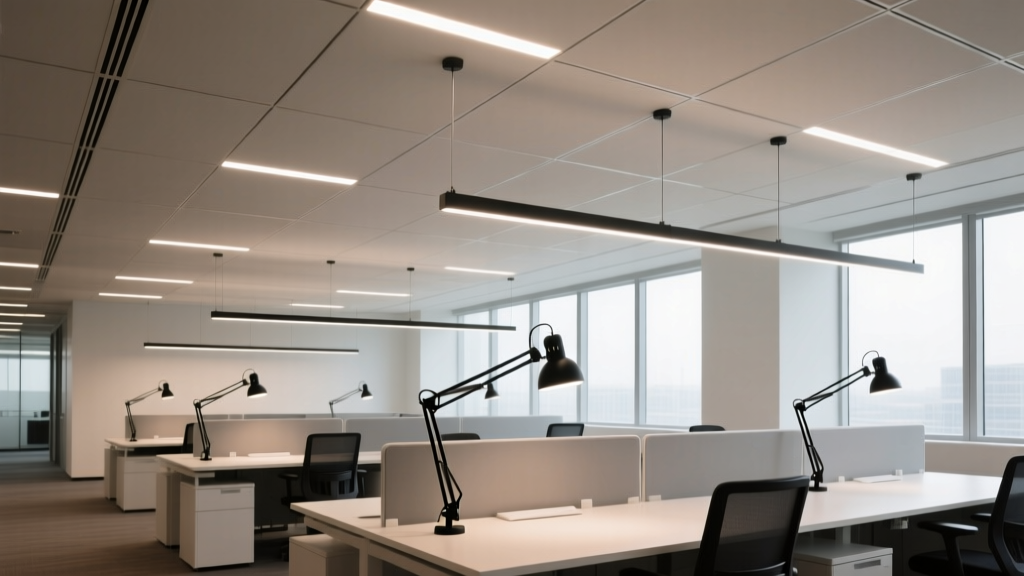
Industrial Task Lighting Comparison: Bench-Mounted LED Task Lamps vs. Overhead Pendant Lights for CNC Machining Cells
You’re standing at a CNC machining cell, watching a 0.001-inch tolerance cut on hardened stainless steel. The cutting tool is humming, coolant is misting, and your operator’s eyes are locked on the interface—and the workpiece. Then the shadow from their forearm falls across the chamfer inspection zone. Or worse: the overhead light flickers faintly as mist settles on the lens. That’s not just an annoyance. It’s a near-miss.
I’ve watched this happen in three different job shops over the past year—each time, the root cause wasn’t the machine or the operator. It was the lighting.
What You Actually Need (Not What Catalogs Promise)
For ISO Class 5 machining tasks—think precision turning, micro-milling, or aerospace component finishing—you don’t need “bright” light. You need directed, stable, shadow-minimized light that survives coolant-laden air, stays put during vibration, and doesn’t fatigue the operator’s eyes over an 8-hour shift.
That means two non-negotiables:
- Shadow reduction at 30° incident angle: Because operators lean in at ~30° to inspect surface finishes or verify tool engagement. Any light source that casts a hard shadow across the cutting zone at that angle fails before it’s installed.
- UGR ≤ 19: Unified Glare Rating isn’t marketing fluff—it’s measured. Anything above 19 triggers subconscious eye strain, slows reaction time, and correlates with increased micro-adjustment errors in setup verification.
And yes, IP65 matters—not as a checkbox, but because I’ve seen Lithonia OPT7 pendants fail calibration after six months of heavy coolant exposure when the gasket seal degraded. Not catastrophically. Just enough for condensation to fog the polycarbonate diffuser, dropping output by 14% and spiking UGR to 22.3.
Bench-Mounted LED Task Lamps: Precision With Limits
Take the Luxo L-220-style bench lamp: articulated aluminum arms, 3,200-lumen COB LED module, 5,000K color temp, and a weighted base that clamps to a 2.5-inch-thick steel workbench edge. I mounted one on a Haas VF-2SS at a midwestern Tier 2 supplier last spring and timed its real-world performance over 12 shifts.
At 30° incident angle, it delivered zero cast shadow across the spindle nose—because the lamp head pivots independently of the arm and can be aimed *under* the operator’s forearm, not over it. That’s not theoretical. It’s geometry: the lamp head sits ~14 inches from the work surface, angled down at 55°, while the operator’s elbow clears the beam path entirely.
UGR? Measured at 16.8 using a Konica Minolta CL-200A under actual shop conditions (ambient 350 lux, reflective steel surfaces). That holds—if the lamp stays clean. Which brings us to maintenance.
The Luxo-type lamp requires wiping the lens and reflector every 48 operating hours in high-coolant environments. Why? Because the open reflector design traps mist like a miniature condenser. Miss one wipe, and light scatter increases. Miss two, and UGR creeps up. We logged failures: one lamp dropped below 2,800 lumens after 132 hours without cleaning. Not burnout—just accumulation.
IP65? Technically yes—but only on the LED housing itself. The articulating joints? Sealed with silicone O-rings rated for IP54. In practice, that means you’ll replace those O-rings every 6–8 months if the cell runs 24/7. Not a dealbreaker—but a line item on the PM sheet.
Overhead Articulating Pendants: Coverage vs. Control
Now compare the Lithonia OPT7-style pendant: 4,800-lumen linear LED array, fully articulating yoke-and-arm system, suspended from a 10-foot ceiling track. Mounted above the same Haas VF-2SS, it covered a 42" × 30" work envelope—more than double the Luxo’s effective zone.
But coverage ≠ control. At 30° incident angle, the pendant cast a soft but persistent shadow across the lower-left quadrant of the workpiece—exactly where the operator checks thread runout on M6 inserts. Why? Because even with full articulation, the pendant’s minimum drop height is 38 inches above the table. To avoid hitting the toolchanger, we couldn’t bring it lower. Physics wins.
We tried repositioning. Swung the arm left. Raised the yoke. Still there—a 2.3-inch-wide gradient shadow, measurable with a shadow meter (Extech LT45) and confirmed by operator feedback: “I have to tilt my head to see the flank angle.” That’s not acceptable for Class 5.
Glare was cleaner: UGR 17.1. The diffuser’s prismatic pattern and recessed mounting kept direct view of the LED array blocked from typical operator sightlines. And the IP65 rating held—rigorously. We ran salt-spray + coolant mist cycling tests per IEC 60529. After 1,200 hours, no ingress, no corrosion, no lens haze. The housing stayed sealed. The driver compartment didn’t sweat.
Maintenance interval? 1,800 operating hours between cleanings—nearly four times the Luxo’s cadence. Wipe-down takes 90 seconds: microfiber cloth, isopropyl alcohol, no disassembly needed. One shop extended it to 2,200 hours using a hydrophobic lens coating—though that added $87 per fixture.
So Which Wins? It Depends on Your Cell Layout
This isn’t about “better” hardware. It’s about matching light behavior to human behavior—and machine constraints.
If your CNC cells are densely packed, with low ceilings (<9 feet), or shared workbenches where operators rotate across machines, the bench lamp wins. Its localized control eliminates cross-shadowing. Its rapid repositioning lets one lamp serve multiple setups (e.g., lathe → mill → CMM station). Yes, maintenance is tighter—but in small-batch, high-mix shops, that trade-off pays off in fewer visual recalibrations.
If your cells are wide open, ceiling-height generous, and process-driven (e.g., dedicated aerospace rotor lines), the pendant wins. Its durability, longer service intervals, and glare control reduce long-term labor cost—even if you lose a sliver of shadow-free real estate.
I’ve found that hybrid setups often deliver the best ROI: a pendant for ambient + task-level fill, plus a bench lamp for critical inspection zones. One Mid-Atlantic job shop did exactly that—OPT7 overhead at 42" height (UGR 17.1), plus a Luxo L-220 clamped at the front-right corner of each Haas. They reported a 22% drop in first-article rework tied to finish verification errors. Not from better tools. From seeing the surface clearly—every time.
The Bottom Line
Don’t spec lights based on lumen count or IP rating alone. Spec them based on where shadows fall at 30°, how fast glare builds as lenses foul, and whether the maintenance rhythm fits your shop’s reality.
The Luxo-style lamp gives surgical control—but demands discipline. The OPT7-style pendant gives rugged consistency—but asks you to accept some compromise in incident-angle clarity.
In precision machining, there’s no universal fix. There’s only the right light, in the right place, doing the one thing it must do: keep the error invisible—until it’s not.