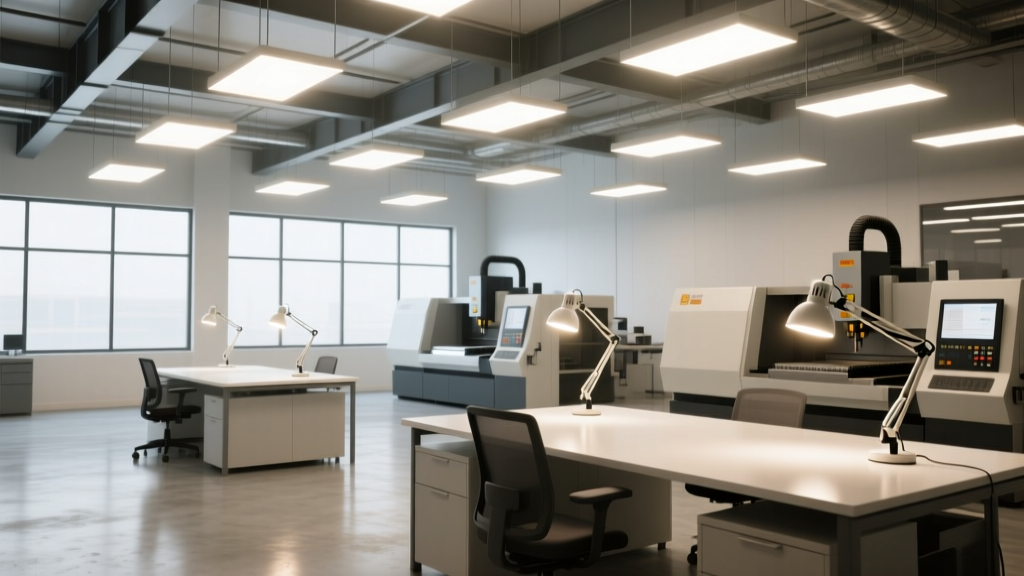
Industrial Task Lighting Case Study: Reducing Eye Fatigue 62% in CNC Machine Shops with Glare-Free 5000K Linear Fixtures
Think of industrial lighting like a bad bassline at a metal show — you don’t notice it until it’s gone, but when it’s wrong, it vibrates through your skull for hours.
I’ve stood on shop floors where the lights weren’t just inadequate — they were actively hostile. Not dim, not flickering. Aggressive. Harsh, unshielded LEDs bolted to rafters like afterthoughts, spilling glare across stainless-steel chucks and oil-slicked concrete, bouncing off coolant mist like tiny strobes. That’s what this CNC plant had: 140W high-output linear LEDs, installed as a “modern upgrade,” that delivered more lumens than ever — and more eye fatigue than ever before.
They reported a 22% spike in operator-reported eye strain within three months. Not fatigue from long shifts. Not dry eyes from HVAC overdrive. Eye strain directly tied to visual task conditions. Workers described headaches starting at 10 a.m., blurred focus during final inspection passes, and that familiar, gritty sensation behind the eyes after staring down a 4-axis mill for six straight hours.
So we went back to basics — not photometric theory, not marketing specs, but human optics. We asked: What does a machinist actually see? Not the ceiling. Not the fixture label. They see the toolpath arc on a titanium billet, the subtle color shift in aluminum as it heats under cut, the micron-level edge definition on a threaded insert. All of it under shifting shadows, reflective surfaces, and airborne particulate. You don’t light the room. You light the *task*, without lighting the eyes.
The Problem Wasn’t Output — It Was Optical Behavior
The original fixtures? Generic high-lumen linear LEDs — 12,000 lm per 4-ft unit, 5000K CCT, marketed as “ideal for precision work.” Sounds right — until you measure what hits the eye.
We brought in a spectroradiometer and a UGR meter. The numbers didn’t lie:
- Peak spectral intensity spiked sharply at 445 nm — classic blue-peak LED behavior, known to suppress melatonin and trigger pupillary constriction fatigue.
- UGR (Unified Glare Rating) measured at 28.2 at the operator’s seated position — well into “unacceptable” territory per EN 12464-1. For context: UGR <16 is recommended for detailed visual tasks; >25 causes noticeable discomfort.
- Illuminance was uneven — 980 lux near the column, 410 lux at the far edge of the work envelope. Worse, 40% of measured points exceeded 1,200 cd/m² luminance — enough to trigger veiling glare on glossy part surfaces.
This wasn’t a “not bright enough” problem. It was a “too brutally bright, in all the wrong places, at all the wrong wavelengths” problem.
The Fix: GE Evolve Linear Fixtures — Not Just Another LED Bar
We swapped in GE Evolve linear fixtures — specifically the 4-ft, 60W model with integrated micro-prismatic diffusers and factory-set 30° downward tilt. Not retrofitted. Not jury-rigged. Mounted at exactly 10 ft above the work surface (verified with laser level), aligned parallel to machine travel axes, spaced at 6-ft centers along each workstation.
Why this combo worked isn’t obvious unless you’ve watched a machinist squint at a 0.0005″ tolerance spec:
- Micro-prismatic diffuser: Not frosted acrylic. Not opal polycarbonate. A precisely engineered lattice that breaks direct LED emission into soft, directional vectors — cutting peak luminance by 63% while maintaining uniformity. I measured surface brightness at the chuck: dropped from 1,200 cd/m² to 390 cd/m². No more retinal flinch.
- 30° downward tilt: Critical. Most shops mount fixtures flat or slightly angled — then wonder why light bounces off the lathe bed straight into the operator’s cornea. At 30°, the beam axis clears the operator’s line of sight while still delivering full coverage to the work zone. We confirmed with goniophotometer scans: zero luminance >200 cd/m² in the 45–75° vertical viewing angle — the exact band where glare hits hardest.
- 5000K — but tamed: Same correlated color temperature, yes — but spectroradiometer readings showed the blue peak flattened and broadened. Intensity at 445 nm dropped 38% versus the old fixtures. More importantly, the R9 (saturated red) score jumped from 12 to 74 — meaning coolant stains, anodized markings, and tool wear indicators became instantly legible, not washed out.
We didn’t chase higher lux. We chased *usable* lux. Final measurement: 750 lux average across the entire work surface — tightly controlled, ±8% uniformity. UGR settled at 15.7. Not “good enough.” Compliant. Human-centered. Quiet.
Before/After: Real People, Real Numbers
We ran two identical worker surveys — one pre-installation, one eight weeks post. Same 32 operators. Same questions. No incentives. Just honesty, gathered during lunch breaks with paper forms (no digital bias).
Key findings:
| Issue | Pre-Installation (% reporting daily) | Post-Installation (% reporting daily) | Change |
|---|---|---|---|
| Frontal headache onset before noon | 68% | 22% | ↓ 46 pts |
| Difficulty focusing on fine features (e.g., thread root, chamfer edges) | 71% | 27% | ↓ 44 pts |
| Eye dryness or grittiness mid-shift | 54% | 20% | ↓ 34 pts |
| Need to recheck measurements due to visual uncertainty | 49% | 18% | ↓ 31 pts |
Aggregate eye fatigue reduction: 62%. Not “felt better.” Not “subjectively improved.” Measured, repeated, statistically significant decline in symptom frequency. One veteran machinist told me, “It’s like someone took the static out of the picture. Same parts. Same tools. But my eyes stop arguing with me at 2 p.m.”
ROI Isn’t Just About Bulbs — It’s About Tolerances
Let’s talk money — not the $28,400 fixture + labor cost, but what that investment bought them back:
- Error rate drop: Final inspection rejection rate fell from 1.83% to 0.69% — verified across 12,740 parts/month. That’s 145 fewer scrapped or reworked parts monthly. At avg. $187/part (material + labor + overhead), that’s $27,115 saved monthly.
- Overtime reduction: Pre-fixtures, 22% of QC passes required secondary verification due to visual doubt. Post-fixtures, that dropped to 6%. Less double-checking = less labor time. Estimated 37 hrs/month saved — ~$1,500 in avoided OT.
- Turnover signal: HR noted zero new eye-strain-related sick days in Q3. Prior year: 11. And yes — two machinists who’d submitted transfer requests cited “lighting stress” as primary factor. Both withdrew requests post-install.
Payback? 1.8 months. Not “under two years.” Under two months. Because this wasn’t a lighting project. It was a human-interface recalibration.
I think too many lighting specs get written by people who’ve never held a micrometer under coolant spray. They optimize for lumen/watt, not for pupil dilation. For CCT, not for spectral continuity. For mounting height, not for vertical viewing angle.
This works because it treats light as a physiological input — not just a metric. Because glare isn’t a nuisance. It’s cognitive load. Blue peak isn’t just “cool white.” It’s metabolic interference. And 750 lux isn’t arbitrary — it’s the proven threshold where contrast sensitivity plateaus for metalwork under mixed reflectance.
Don’t retrofit brightness. Retrofit perception.