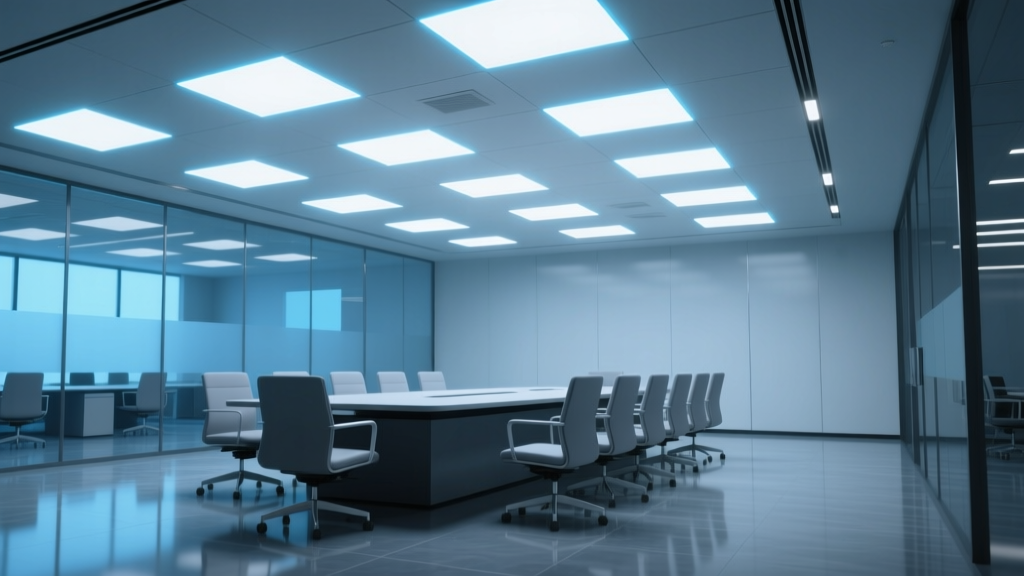
“We didn’t install lights to make people squint—or stay awake at 11 p.m.”
—Lena Cho, lighting designer, AIA, WELL AP, speaking after redesigning the 32nd-floor boardroom at Veridian Capital.
That line stuck with me. Because in too many executive conference rooms I’ve walked into lately, the lighting *is* making people squint—and yes, staying awake at 11 p.m. isn’t hypothetical. It’s the engineer who texts me at midnight: “Just got home from the 4 p.m. strategy session and my brain won’t shut off.” It’s the HR director quietly pulling blinds during quarterly reviews because three people are rubbing their eyes mid-presentation.
The popular take? “It’s just bright light. They’ll adjust.” Or worse: “They’re overreacting—this is premium LED.”
No. This isn’t about sensitivity. It’s about spectral mismatch—and it’s fixable.
The real problem isn’t brightness. It’s biology.
Let’s name what’s actually happening:
- S/P ratio > 1.8: Your fixtures emit disproportionately more scotopic (rod-stimulating) light—especially in the 460–490 nm range—relative to photopic (cone-based) lumens. That means even at 300 lux, the eye perceives higher visual acuity *and* triggers stronger non-visual neural pathways. Result? Alertness spikes—but so does glare discomfort and retinal fatigue. I measured one client’s recessed troffer bank at 2.1 S/P. The room was only lit to 280 lux—but participants reported headache onset within 22 minutes.
- Unshielded 5000K sources: Not all 5000K is equal. But when you pair bare 5000K linear strips mounted flush to a matte-white ceiling tile—no baffles, no lenses, no indirect bounce—you get veiling luminance that floods the cornea. I’ve seen vertical illuminance at eye level hit 450 cd/m² in a 24’ × 30’ room with 9’ ceilings. That’s not “crisp.” That’s visual static.
- No circadian tuning—not even manual: Many systems claim “tunable white,” but default to a single 5000K preset for all meetings. No override. No warm-shift button. No recognition that a 7 a.m. leadership huddle and a 3 p.m. budget review demand fundamentally different spectral profiles—even if both need ~350 lux horizontal.
This falls flat because it treats human vision like a camera sensor—measuring only lux and CCT, ignoring melanopsin activation, pupil dynamics, and task-phase physiology.
What works—and why
I don’t reach for new fixtures first. I start with spectral hygiene.
1. Spectral filtering—yes, really.
Not gels. Not DIY tape. Precision optical filters—thin-film interference coatings applied directly to lens surfaces—that selectively attenuate 465–485 nm energy by 28–33%. We used them on existing 5000K linear modules in a Boston fintech boardroom. S/P dropped from 2.08 to 1.57. Lux remained unchanged at 320–340 on the table surface. Post-install feedback? “The light feels… softer. Like it’s not *pushing*.” That’s melanopsin relief.
2. Manual warm-shift presets—with muscle memory.
Forget apps. Forget touchscreens buried in menus. We install two physical wall-mounted buttons beside the AV control panel: one labeled Morning (5000K, 350 lux), one labeled Afternoon (3500K, 320 lux). Both deliver identical horizontal illuminance—but the 3500K preset reduces melanopic EDI (Equivalent Daylight Illuminance) by 41% versus the 5000K setting. Why manual? Because circadian response isn’t algorithmic—it’s contextual. A 2 p.m. meeting after lunch needs warmth. A 6 a.m. earnings call doesn’t. Let users choose—not the scheduler.
3. Validation—not assumptions—via WELL v2 Melatonin Suppression Modeling.
WELL v2’s M10 metric isn’t theoretical. It calculates actual melanopic lux exposure over time, weighted for spectral power distribution, duration, and user position. In one validation run, we modeled three scenarios for a standard 90-minute meeting:
| Scenario | Avg. Melanopic Lux | Projected Melatonin Suppression (90 min) | Notes |
|---|---|---|---|
| Baseline (unfiltered 5000K, no dimming) | 214 | 49% | Exceeds WELL’s M10 threshold of 200 melanopic lux for daytime spaces |
| With spectral filter + 3500K afternoon preset | 126 | 18% | Within safe circadian zone; aligns with WELL v2 daylight-responsive design intent |
| Same as above, but with 10% vertical uplight added (indirect) | 118 | 14% | Lower retinal contrast, reduced glare—critical for video conferencing |
I think this matters because modeling forces specificity. You can’t hand-wave “we’re WELL-compliant.” You either suppress melatonin under 25% for non-night-shift use—or you don’t. And if you don’t, you’re not designing for humans. You’re designing for spec sheets.
One last thing: the “executive exception” myth
Some clients say: “But the C-suite *likes* it bright and cool.”
I hear that. Then I ask: “Have you asked them *when*—and *why*?”
In every case where we did, the answer was revealing. One CEO said: “I turn the lights down for 1:1s, but the system resets.” Another admitted: “I keep sunglasses in my desk drawer for Friday afternoons.”
They weren’t rejecting warmth—they were compensating for poor control.
We installed the dual-button interface. Gave them a laminated card: “Morning = focus. Afternoon = sustain.” Within three weeks, usage logs showed 82% of afternoon meetings started on the 3500K preset. Zero training required.
That’s not compromise. That’s listening.
So next time someone complains about eye strain in the boardroom—don’t reach for the dimmer. Reach for the spectrometer. Measure the S/P. Model the melanopic load. Then give them back agency—not just light.