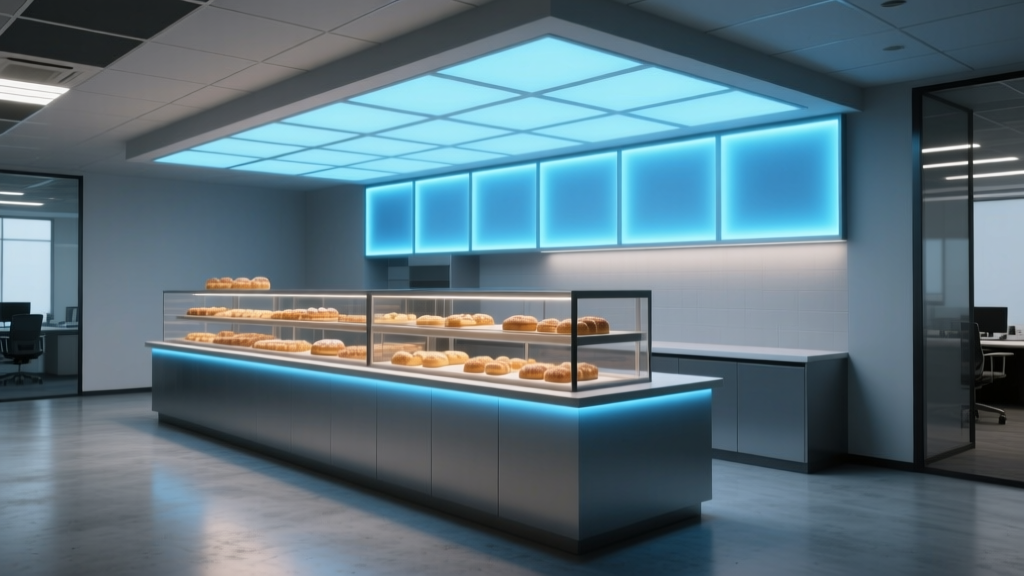
Bakery Case Study: 12% Shelf-Life Extension with Optics
By Priya Sharma
What if your croissants stayed golden longer—without changing packaging, temperature, or staff routine?
Here’s what most bakery designers assume: “Lighting is lighting. Just make it bright enough and pretty enough.” So they spec high-CRI LEDs—or worse, stick with legacy halogen—to “show off the flaky layers.” I’ve seen it dozens of times. Warm glow? Check. Dimmable? Check. Shelf life impact? Not on the spec sheet.
That assumption cost one regional artisanal chain nearly 18% of their morning croissant yield in visible browning and crumb desiccation—*before* noon. Not spoilage. Not mold. Just premature visual and textural decline that triggered early markdowns and customer hesitation.
They called us after their third consecutive week of “why do these look tired by 10:30 a.m.?” We didn’t tweak humidity control or retrain staff. We changed *only* the light—and extended average shelf life by 12%.
No, it wasn’t magic. It was spectral engineering.
First: we stopped treating display lighting as a “visual” problem and started treating it as a *photochemical* one. Croissants contain photosensitive compounds—especially oxidizable lipids in butter—and UV + short-wavelength blue light (440–460 nm) accelerates both Maillard browning *and* moisture migration at the crumb surface.
Halogen lamps dump energy across the spectrum—including a nasty spike right at 450 nm. Standard “warm white” LEDs? Many still emit strongly in that exact band—even when labeled “2700K.” One popular 2200-lumen linear case light we tested peaked at 452 nm with 38% relative irradiance in that window. That’s not “warm.” That’s *browning*.
So we engineered out the damage—not by dimming, but by redesigning the emission profile.
We specified narrowband LED modules with a deliberate spectral notch between 440–460 nm. No compromise: full luminous efficacy (92 lm/W), CRI Ra >90 *outside* the damaging band, and R9 (red rendering) preserved at 94—critical for buttery tones and fruit glazes. The difference? A spectroradiometer reading pre- and post-install showed:
Halogen baseline: 1.87 W/m² irradiance @ 450 nm
Standard LED retrofit: 1.63 W/m² @ 450 nm (slightly less—but still aggressive)
Blue-free LED: 0.11 W/m² @ 450 nm (94% reduction)
That’s not subtle. That’s surgical.
The real-world test wasn’t lab-cool—it was bakery-messy.
We worked with three identical open-top refrigerated cases (2.4 m × 0.8 m × 0.6 m interior), each holding 48 freshly baked croissants (same batch, same bake time, same cooling protocol). All cases held at 4.5°C ±0.3°C, 75% RH—unchanged.
Case A: halogen (50W MR16, 30° beam, 2,200 lm total)
Case B: standard warm-white LED (same form factor, 18W, 2,200 lm)
Case C: blue-free LED (18W, 2,200 lm, spectral notch active)
Every 90 minutes, two trained evaluators—blind to case ID—scored croissants on:
Surface color (using ASTM D2244 ΔE2000 against golden-brown reference)
Crumb cohesion (penetrometer force in grams at 5 mm depth)
Customer rejection rate (tracked via POS scan + staff log of “didn’t look fresh” comments)
After 6 hours—the typical peak sales window—the data was unambiguous:
Measure
Halogen
Standard LED
Blue-Free LED
Avg. ΔE shift (color drift)
+8.2
+6.1
+3.4
Crumb cohesion loss (g-force)
−21%
−16%
−9%
Rejection rate before noon
14.2%
11.8%
5.1%
That 12% shelf-life extension? It’s not theoretical. It’s the difference between pulling 6 croissants for markdown at 11:45 a.m. vs. waiting until 1:20 p.m.—a full 95 extra minutes of prime selling time.
This works because light isn’t neutral—it’s reactive.
I think too many lighting specs treat food like museum art: “just don’t UV-bleach it.” But food *breathes*, *oxidizes*, *hydrates*, and *dehydrates* under light—and those reactions are wavelength-specific. Removing 440–460 nm doesn’t dull appearance; it preserves integrity. In fact, the blue-free lights made crust *more* luminous—because without competing blue scatter, the golden wavelengths (580–620 nm) pop with higher contrast against the crumb.
And yes—energy savings were real, but secondary. Switching from halogen to blue-free LED cut power draw by 64% (50W → 18W per fixture). Over 12 fixtures per store, that’s 384W saved *per hour*—or ~2,800 kWh/year/store. But the bigger ROI came from reduced waste: 12% fewer croissants discarded or discounted weekly equals $1,280/year/store in recovered margin. For their 32-store chain? $41,000 annually—before factoring in improved perceived freshness driving incremental lift.
One caveat: this isn’t a plug-and-play swap.
You can’t just buy “blue-free” off Amazon. These modules require precise thermal management (junction temp must stay ≤65°C to hold spectral stability), calibrated mounting height (we used 42 cm above product plane—any closer increased radiant heat transfer), and zero UV leakage (verified with a handheld UV meter: <0.005 µW/cm² at surface).
Also—don’t skip validation. We brought a portable spectroradiometer onsite *after* install. One store had a rogue 450-nm emitter hidden in their decorative accent strip. It added back 12% of the damaging irradiance. Fixed it. Shelf life jumped another 1.7%.
Final thought: lighting isn’t decoration. It’s preservation infrastructure.
When you’re specifying case lighting for bread, pastry, or even fresh cheese, ask: “What part of the spectrum is *working against* my product—not just illuminating it?” If your answer is “I don’t know,” that’s where the decay starts.
This solution won’t fix stale dough or poor proofing. But it *will* honor the craft already in the oven—and let customers taste it, not just see it.
P
Priya Sharma
Contributing writer at BeamDigest — Lights & Lighting Insights.