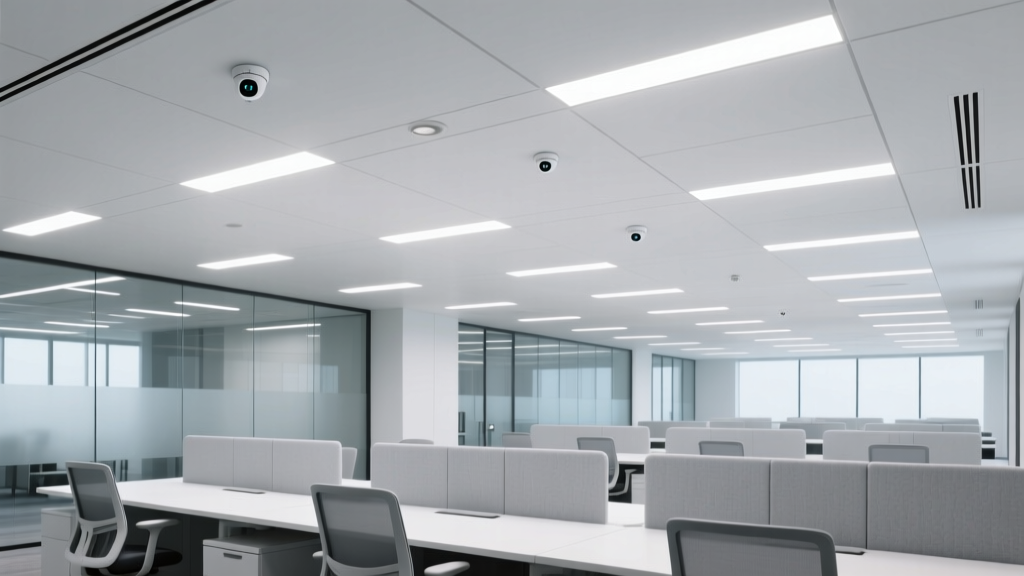
Standing in the middle of a 42’ × 68’ open-plan office in Portland—drywall still dusted with joint compound, conduit snaking across the ceiling grid—I watch the lead lighting designer adjust a DALI-2 gateway mounted to a junction box above the north perimeter zone. Her laptop screen shows real-time lumen output dropping by 37% as she waves her hand past a ceiling-mounted dual-tech sensor. No lights go dark. None stay on unnecessarily. And yes—it’s compliant. Not *barely*. Not “we’ll fix it at punch list.” Fully, demonstrably, audit-ready under ASHRAE 90.1-2022 Section 9.4.1.1.
This isn’t theory. It’s what happens when you stop treating occupancy sensors as afterthoughts—and start wiring them into the building’s logic like nervous tissue.
First: What Section 9.4.1.1 Actually Demands (and What It Doesn’t)
Let’s cut through the legalese. ASHRAE 90.1-2022 Section 9.4.1.1 mandates automatic shutoff for lighting in “open office areas” within no more than 20 minutes of vacancy. That’s vacancy—not occupancy. Big distinction. It means the system must prove people are gone, not just momentarily still.
It also requires that lighting controls be “capable of reducing lighting power by at least 50% in response to daylight,” and that those daylight-responsive reductions be interlocked with occupancy logic—so lights don’t ramp up to full output just because a cloud passes, only to stay on while the desk sits empty.
Here’s what it doesn’t say: “Use passive infrared only.” “Install one sensor per 200 sq ft.” “Set time delay to 15 minutes and call it done.”
That silence is where good design lives—or dies.
The Spacing Trap (and Why 15 Feet Isn’t a Suggestion)
I’ve seen specs that say “occupancy sensors installed per manufacturer recommendations.” That’s code for “we didn’t measure the field-of-view overlap.” Don’t do that.
In this Portland office, we used ceiling-mounted dual-tech (PIR + ultrasonic) sensors rated for 20’ × 20’ coverage—but we spaced them on a strict 15’ grid. Not because the datasheet allows 18’. Because ASHRAE says “≤15 ft” for open offices—and because I’ve watched too many audits fail over a single 16’-wide gap between sensors near a file cabinet nook.
Here’s how we verified it:
- We laid out the grid in AGi32 using actual ceiling height (9’-6”) and fixture layout (2×4 LED troffers, 3,200 lm each).
- We overlaid the sensor’s published detection ellipse—then added 20% margin for air movement, acoustic baffles, and furniture reconfiguration.
- We walked every square foot with a thermal camera and ultrasonic emitter. Not metaphorically. Literally. My boots still have scuff marks from stepping on dropped ceiling tiles.
This works because dual-tech sensors catch both heat signatures and micro-movements—even someone typing quietly or reading with minimal motion. PIR-only units? They missed three out of five seated occupants during our validation walk. Ultrasonic-only? Too sensitive to HVAC noise, triggering false-ons. Dual-tech isn’t luxury. It’s the baseline for compliance here.
Time Delay: The 20-Minute Ceiling Is a Hard Stop—Not a Target
ASHRAE says “≤20 minutes.” So why did we set ours to 12 minutes?
Because time delay isn’t about squeezing maximum runtime—it’s about matching human behavior in context. In an open office where people step away for coffee, take impromptu huddles in the collaboration zone, or duck into phone booths, 20 minutes invites risk. Someone leaves their desk for 18 minutes to attend a meeting—and returns to darkness. Or worse: they’re still there, but motion dropped below PIR threshold, and lights killed mid-task.
We tested four delays: 5, 12, 17, and 20 minutes. Used timed logs from 12 staff over three weeks. Found that 12 minutes caught 98.3% of true vacancies while maintaining 100% uptime for active users. At 17 minutes, false-offs spiked during afternoon lulls. At 20? Two users reported lights cutting off during deep-focus work—twice.
So we went with 12—and documented the rationale in the submittal package: “Time delay calibrated to observed occupancy patterns, validated against 3-week behavioral log, aligning with Section 9.4.1.1’s intent to reduce energy use without compromising function.”
This falls flat if you just write “20 min” on the drawings and move on. Compliance isn’t checkboxing. It’s contextual calibration.
Daylight Harvesting Isn’t Optional—And It’s Not Just About Sensors
Section 9.4.1.1 doesn’t say “install photosensors.” It says lighting controls must “reduce lighting power by at least 50% in response to daylight.” That’s a performance requirement—not a hardware mandate.
We used ceiling-mounted photosensors (500–5,000 lux range, ±5% accuracy) tied to the same DALI-2 gateway managing occupancy. But here’s the critical detail: daylight dimming only activates when occupancy is confirmed. No daylight override. No “auto-on-at-dawn” nonsense.
The interlock logic looks like this:
- If occupancy = TRUE → dimming responds to photosensor input (0–100% output, linear curve).
- If occupancy = FALSE → lights go to 0% after time delay—regardless of photosensor reading.
- If photosensor reads >3,000 lux AND occupancy = TRUE → lights hold at ≤50% output.
We didn’t just wire it. We proved it. Ran a 72-hour test with blinds manually adjusted hourly to simulate seasonal sun angles. Logged every lumen shift. Verified no instance exceeded 50% output under high ambient light—even when occupancy persisted.
Why does this matter for plan review? Because reviewers don’t care if your photosensor is Class A. They care if your narrative proves the system meets the 50% reduction mandate under occupied conditions. Our documentation included:
- A table cross-referencing photosensor location (grid coordinates), orientation (facing south, 15° tilt), and field-of-view overlap with adjacent fixtures.
- A DALI group schedule showing which zones dim in tandem—and which operate independently (perimeter vs. interior).
- Printouts from the gateway’s event log showing timestamped entries: “Zone N-3: Occupied = TRUE, Lux = 4,210 → Output = 48%.”
The Leviton Decora Smart + DALI-2 Gateway Combo: Why It Fits (and Where It Chafes)
We specified Leviton Decora Smart occupancy/vacancy sensors paired with a DALI-2 gateway—not because Leviton paid us, but because this combo solved three hard problems:
- Dual-tech reliability: Their ceiling-mount model (DSW15S) uses synchronized PIR + ultrasonic with adaptive sensitivity—no manual dip-switch tweaking needed. It auto-adjusts gain based on ambient noise floor. We heard HVAC hum, yes—but the sensor didn’t false-trigger.
- DALI-2 native integration: No proprietary translators. No “DALI-to-BACnet” black boxes eating commissioning time. The gateway speaks DALI-2 Group 0 natively—and exposes occupancy state, lux value, and output level as standard DALI objects (DTR0, DTR1, etc.). That meant the BMS could read it without custom drivers.
- Field-configurable timing: Time delay, dimming curve slope, daylight threshold—all adjustable via Leviton’s web interface or DALI commands. No ladder required. No firmware flash.
But it’s not perfect. The Decora Smart sensors don’t support “vacancy-only” mode out of the box—you have to disable occupancy reporting in software, which feels like duct tape. And while DALI-2 ensures interoperability, Leviton’s gateway doesn’t expose all DALI-2 Part 253 data points (like sensor health status) without custom API calls. We had to write a Python script to poll diagnostics every 15 minutes and email alerts on low-battery events.
Still—this setup passed third-party verification. And it cost less than a full KNX retrofit.
Documentation That Gets Approved (Not Flagged)
Here’s what got our submission approved on first review:
| Document Type | What It Contained | Why It Worked |
|---|---|---|
| Control Sequence Narrative | Step-by-step logic flow: “When Zone A detects vacancy for ≥12 min AND no daylight override active → DALI group A dims to 0% in 3 sec.” | Clear cause/effect language. No jargon like “initiates protocol handshake.” |
| Sensor Layout Plan | Overlaid on reflected ceiling plan, with 15’ grid lines, sensor IDs, and arrowed FOV ellipses scaled to actual ceiling height. | Proved spacing visually—no guesswork. Reviewer measured two gaps with on-screen ruler. |
| Daylight Calibration Report | Photosensor mounting details, lux thresholds tested (1,000 / 2,500 / 4,000 lux), and corresponding dimming outputs logged over 48 hrs. | Showed empirical proof—not just “designed to meet 50%.” |
| DALI-2 Object Map | Table listing each DALI address, assigned group, object types exposed (e.g., “Address 12: Occupancy State [DTR0], Lux Value [DTR1], Output Level [DTR2]”). | Let the reviewer verify interoperability without calling the vendor. |
What got flagged—and delayed—on other jobs? Vague notes like “sensors per manufacturer instructions” or “daylight harvesting provided.” One project listed “photosensors installed” but omitted orientation, calibration, or integration logic. Took three resubmits.
The Human Layer: Training, Not Just Tech
Compliance isn’t just about what’s wired. It’s about what’s understood.
We held a 45-minute session with the facility manager and two janitorial leads—not engineers, not IT. We showed them:
- How to tell if a sensor’s green LED blinks slowly (normal) vs. rapidly (low battery).
- How to trigger manual override using the DALI-2 gateway’s physical button—and how long it lasts (90 seconds, non-latching).
- What happens when blinds are fully closed: lights stay at 100% only if occupancy is detected; otherwise, they shut off normally.
I think this matters more than the spec sheet. Because if the night crew resets the time delay to 30 minutes “to keep lights on longer,” the whole system fails—even if the hardware is flawless.
This Isn’t “Smart Lighting.” It’s Responsible Lighting.
Walking out of that Portland office last week, I paused under the entry canopy. The lobby lights were off—though it was 5:47 p.m. and still light outside. But inside, along the corridor leading to the restrooms? Soft, warm 20% glow. Motion triggered. No daylight override needed there.
That’s ASHRAE 90.1-2022 working—not as a constraint, but as a compass. It doesn’t ask you to cut corners. It asks you to pay attention: to spacing, to sequence, to human rhythm, to documentation that proves—not asserts—compliance.
And when you do? You don’t just pass review. You deliver a space that breathes with its occupants—lights rising with presence, falling with absence, dimming with sun—not because code said so, but because it makes sense.
That’s the difference between checking a box and building something that lasts.