ASHRAE 90.1-2022 Lighting Controls in Your Medical Office Waiting Room: What “Area Type” Actually Means on Plan Review Day
You’re standing in front of a set of stamped plans for a 3,500-sq-ft outpatient clinic — waiting room up front, four exam rooms down the hall, admin offices tucked behind. You’ve spec’d LED troffers at 35 lumens/W, added dimmable drivers, even modeled daylight zones in your energy model. But the plan reviewer just flagged Section G3.2 with a red pen: “Waiting Area controls incomplete per Table G3.2.”
That’s not about watts or efficacy. It’s about area type. And under ASHRAE 90.1-2022, “Waiting Area” isn’t a soft descriptor — it’s a code-defined classification with hard control requirements. Get it wrong, and you’ll be revising during construction, not before.
First things first: “Waiting Area” is its own row in Table G3.2 — and it’s not grouped with “Lobbies” or “Corridors”
I’ve seen too many architects lump the waiting room into “Public Areas” or assume it’s covered by the same rules as reception. It’s not. Table G3.2 (in Appendix G) lists “Waiting Areas (Medical)” as a distinct area type — separate from “Lobbies,” “Corridors,” and even “Exam Rooms.” That matters because each has different lighting control mandates.
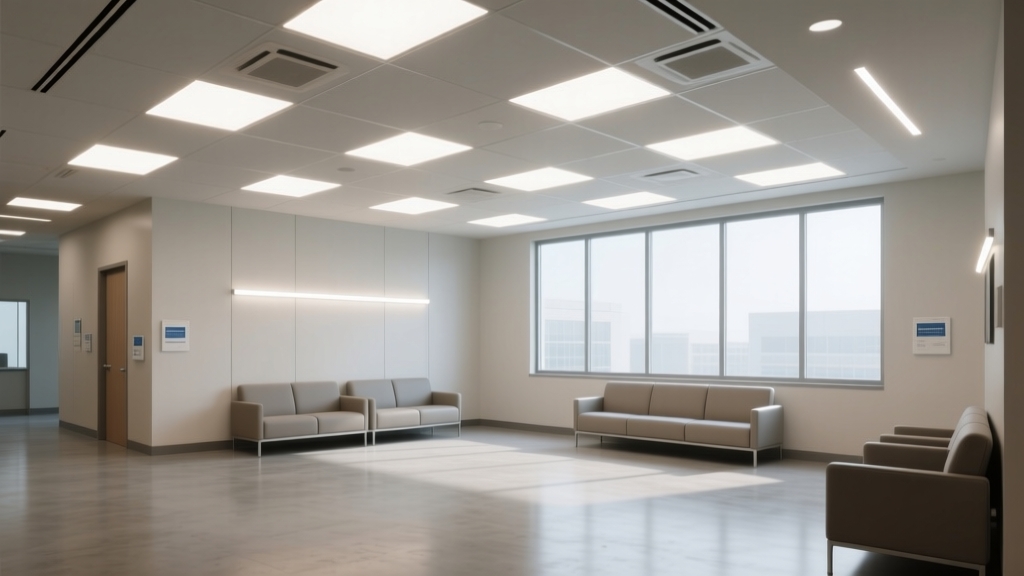
For your 3,500-sq-ft clinic, the waiting room — say, 600 sq ft, open to the entry vestibule, with two large north-facing windows and a glass partition to the corridor — falls squarely under this classification. Why? Because ASHRAE defines it functionally: spaces where patients and visitors remain seated for extended periods prior to service, typically with variable occupancy patterns and significant daylight access. Not “public circulation,” not “staff-only.” It’s patient-facing, stationary, and often unoccupied for long stretches between appointments.
This distinction triggers three mandatory controls — all required *simultaneously*:
- Occupancy sensing (with automatic shutoff within 20 minutes of vacancy)
- Daylight harvesting (continuous dimming in daylight zones)
- Time-based shutoff (scheduled off-hours shutdown, including weekends)
No “or.” No “if feasible.” All three. And they must be documented, coordinated, and verified — not just noted in a spec sheet.
Occupancy sensors: Where placement kills compliance (and why IES RP-22 isn’t optional)
Yes, you need occupancy sensors. But slapping a ceiling-mount PIR in the center of a 30’x20’ waiting room won’t cut it — especially if there are low-slung lounge chairs, tall potted plants, or a reception desk that blocks line-of-sight.
ASHRAE 90.1-2022 defers to IES RP-22-22, Recommended Practice for Lighting Controls for sensor layout. That means you must:
- Divide the space into sensor coverage zones, not just one big zone — especially with furniture groupings. I’ve found 12’x12’ zones work well for standard waiting layouts with 4–6 chairs per cluster.
- Verify line-of-sight coverage for both horizontal and vertical detection. A sensor mounted at 9’ AFF must see seated occupants’ shoulders and heads — not just their heads when standing. That usually means mounting no higher than 8’6” above finished floor, or using dual-technology (PIR + ultrasonic) sensors near seating clusters.
- Account for “unoccupied but occupied” edge cases: a patient asleep in a chair, someone reading quietly in a corner. RP-22 recommends ≥ 30-second dwell time before declaring vacancy — and requires manual override capability (a wall switch labeled “OCC BYPASS”) within 6’ of every entrance.
In practice: For your 600-sq-ft waiting room, I typically specify four dual-tech sensors — two over the main seating zone near windows, one near the magazine rack, one near the restroom corridor entry — all tied to a single control panel that logs vacancy events. That satisfies both the 20-minute shutoff and RP-22’s spatial fidelity requirements.
Daylight harvesting: It’s not just “add a photosensor” — it’s zone mapping + dimming range + calibration
Your waiting room has those two north-facing windows — great for natural light, terrible for compliance if you treat them like an afterthought.
Under Table G3.2, daylight harvesting is mandatory. That means:
- A defined daylight zone: 15’ deep from the window wall (per ASHRAE’s default), or calculated via simulation if glazing exceeds 40% wall area (yours is ~32%, so 15’ holds).
- Continuous dimming — not step-dimming — for all luminaires in that zone. Your 2×4 LED troffers must be dimmable to 10% output minimum (per ANSI C78.36), not just 20%.
- A photosensor mounted where it sees direct sky view (not blocked by blinds or signage), calibrated to maintain 30 fc average on the horizontal work plane — not 50 fc, not 20 fc. That target is baked into the code’s energy budget.
Here’s what trips people up: The photosensor doesn’t control *only* the daylight zone. It must be integrated with the occupancy system so that lights don’t ramp up unnecessarily when no one’s present — and so daylight dimming stays active even during scheduled “off” hours if security lighting is on (more on that below).
Time-based shutoff: Yes, even for 24/7 clinics — but with smart exceptions
Your clinic may run 7 a.m.–7 p.m., Monday–Friday — but security systems, fire alarm strobes, and overnight cleaning crews mean some lights stay on.
ASHRAE 90.1-2022 allows exceptions to time-based shutoff — but only for lighting required for life safety, security, or maintenance. And those exceptions must be:
- Documented in writing (e.g., a narrative in your submittal stating which fixtures serve egress paths or camera coverage)
- Physically separated (dedicated circuits or branch circuits — no shared breakers with general lighting)
- Limited in scope: Only the minimum needed — e.g., one 15-W LED wall pack per exit door, not full ambient lighting
In your waiting room, that likely means: the two 15-W LED path lights along the egress route to the rear exit (not the main entrance), plus maybe one 20-W fixture over the security keypad near the front door. Everything else — all troffers, all accent lights, all reception desk task lighting — must shut off on schedule.
I recommend labeling these exception circuits clearly on panel schedules: “SECURITY – EXEMPT G3.2.4(b).” It saves review time — and avoids last-minute field changes.
The real-world test: How to prove it works before the stamp hits your plans
Plan reviewers don’t care about theory. They want evidence that your controls will perform as intended — and that starts with documentation, not just product data sheets.
For your submission, include:
- A lighting control schematic showing sensor zones, daylight zones, and circuit grouping — with clear callouts to IES RP-22 figures for sensor layout
- A control sequence narrative (one paragraph max) explaining priority logic: e.g., “Daylight dimming is active only during occupancy; time-based shutoff overrides occupancy during non-business hours unless security circuit is energized.”
- A photosensor calibration note specifying target illuminance (30 fc avg), measurement plane (30” AFF), and integration time (≥15 seconds per IES LM-83)
- A fixture schedule highlighting dimming capability (0–10V or DALI), min dim level (≤10%), and compatibility with specified sensors and controllers
One thing I always add — and it’s saved me twice — is a sensor location overlay on the reflected ceiling plan. Not just “Sensor A,” but “Dual-tech, 8’6” AFF, covers Zone 1 (chairs 1–4), line-of-sight verified per RP-22 Fig. 5.3.” That kind of specificity tells the reviewer you’ve done the homework — not just checked a box.
Final thought: This isn’t about passing review — it’s about predictable operation
I’ve walked into clinics six months post-occupancy where the waiting room lights flicker at noon because the photosensor was mounted behind a shelf, or where the occupancy sensor misses people sitting sideways in lounge chairs. Those aren’t code violations on paper — they’re functional failures that erode trust, waste energy, and trigger service calls.
Treating “Waiting Area” as a defined area type — with its three layered controls — isn’t bureaucracy. It’s designing for how people actually wait: quietly, intermittently, in changing light. When you layer occupancy sensing, daylight response, and time-based logic correctly, you get lighting that feels invisible — until someone notices how comfortable and consistent it is.
That’s the kind of detail that gets your plans approved fast — and keeps your client calling you back for the next build-out.