That Glare on Your Monitor Isn’t Just Annoying—It’s a Layout Failure
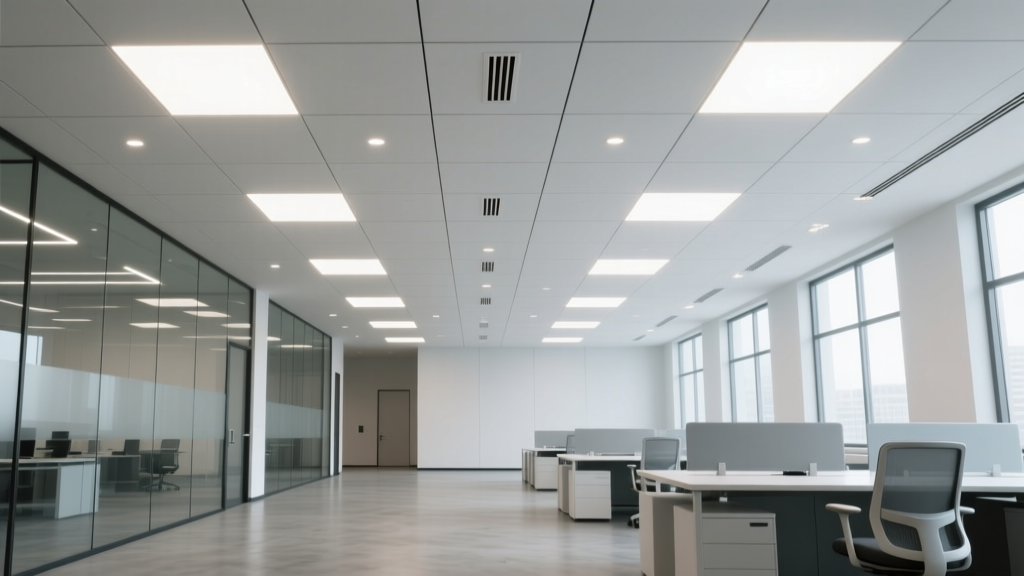
I stood in the third-floor open office of a Portland architecture firm last week—12-foot ceilings, clean white drywall, and 30-inch dual-monitor workstations spaced 6 feet apart. But every desk had that telltale shimmer: a hot spot on the left monitor, a dull gray wash on the right, and one designer squinting at her screen while adjusting her chair *up*, then *back*, then *down* again—not because of ergonomics, but because the light was fighting her. The culprit? A grid of 2×2 LED panels hung flush, spaced 8 feet apart, aimed straight down. It looked tidy on paper. In reality? Vertical illuminance at 40 inches—where eyes meet screens—measured just 9 fc. UGR clocked in at 21. And between fixtures? A 3-foot-wide band where task lighting dropped below 15 fc. Not enough for reading fine line weights. Not enough to keep focus from drifting. This isn’t about “more light.” It’s about *where* the light lands—and how it lands *on people*, not just surfaces.Why 12′ Ceilings Break Traditional Spacing Rules
At 12 feet, the inverse square law bites hard. A 2×2 panel rated at 4,200 lumens (typical for high-CRI, 4000K commercial-grade) delivers roughly 30 fc on the horizontal workplane *if* it’s centered and unobstructed. But vertical planes—like monitor faces or faces turned toward colleagues—are another story. I ran three AGi32 models side-by-side:- Flush-mounted 2×2s, 8′ × 8′ grid
- Surface-mounted with 6″ downrod, same spacing
- Indirect/direct hybrid panels, mounted 10″ below ceiling (so 11′-2″ mounting height)
The Fix Isn’t Higher Output—It’s Smarter Distribution
What worked wasn’t brighter panels. It was *how* the light spreads. Hybrid 2×2 panels—with 70% indirect (upward-facing LEDs bouncing off ceiling), 30% direct (downward-diffused)—changed everything. AGi32 showed vertical illuminance at 40″ jumping from 9 fc to 22–24 fc across the full workstation width—not just under the fixture, but *between* them. Why? Indirect light lifts ambient brightness *evenly*. It softens contrast. It reduces the luminance differential between screen and surround—critical for UGR compliance. And because the ceiling acts as a secondary source, dark zones evaporate. But—and this is non-negotiable—the ceiling must be matte white, ≥0.8 reflectance. I tested with a beige acoustic tile (0.55 reflectance) in the same model: vertical fc dropped by 35%, UGR jumped to 18.2. So yes, finish matters. More than most specsheets admit.Spacing That Actually Works (Not Just Looks Symmetric)
Forget 8′ × 8′ grids. At 12′ ceilings, here’s what AGi32 validated for dual-monitor desks (60″ wide, 30″ deep, centered under fixture):- Fixture spacing: 6′-6″ × 6′-6″ (center-to-center). Tighter than typical, yes—but necessary to eliminate the trough between beams.
- Mounting height: 11′-2″ (10″ below ceiling). This gives downward light enough angle to reach vertical planes without hotspotting monitors—and upward light enough throw to evenly illuminate the ceiling plane.
- Panel spec: 4,200-lumen output, 4000K, CRI ≥90, with asymmetric optical control: 30° cutoff for direct component, 120° spread for indirect.
What Falls Flat (And Why)
Some common “fixes” made things worse:Adding task lights? Only if they’re low-glare, switchable, and positioned *behind* the monitor—not beside it. One client installed arm-mounted LEDs at desk level. They raised horizontal fc to 50+… and spiked UGR to 24. The glare wasn’t on the screen—it was on the *user’s retina*, reflected off the glass.
Switching to 2×4 panels? Larger footprint didn’t help. At 12′, they created harsher transitions—wider shadows, sharper contrast bands. Vertical fc improved slightly under center, but dropped to 12 fc at monitor edges. Not acceptable for CAD review or code-checking.
Using “glare-free” baffles alone? Baffles reduce direct glare, yes—but they also cut total lumen delivery. In one test, adding deep parabolic louvers dropped system efficacy by 18%. We gained UGR compliance but lost vertical fc—back to 17.5. Trade-offs need justification, not assumption.
Final Layout Rule You Can’t Skip
Align fixture centers with desk centers—not aisle lines or column grids. Dual-monitor workstations aren’t symmetrical in use: users rotate left/right, glance up at whiteboards, shift posture. If your grid is tied to architecture instead of human behavior, you’re optimizing for drawings—not people.
I’ve seen firms spend $200K on lighting only to rewire half the floor because fixtures were placed over structural beams—not over heads. AGi32 doesn’t care about beam depth. People do.
Bottom Line
This works because it treats light as a spatial tool—not a ceiling decoration. Hybrid 2×2s at 11′-2″, spaced 6′-6″, over matte-white ceilings deliver what designers, drafters, and developers actually need: consistent vertical light, low glare, zero visual fatigue zones.
It falls flat when we treat lighting like furniture—something to fill space evenly. Good office light doesn’t cover area. It covers *attention*.